
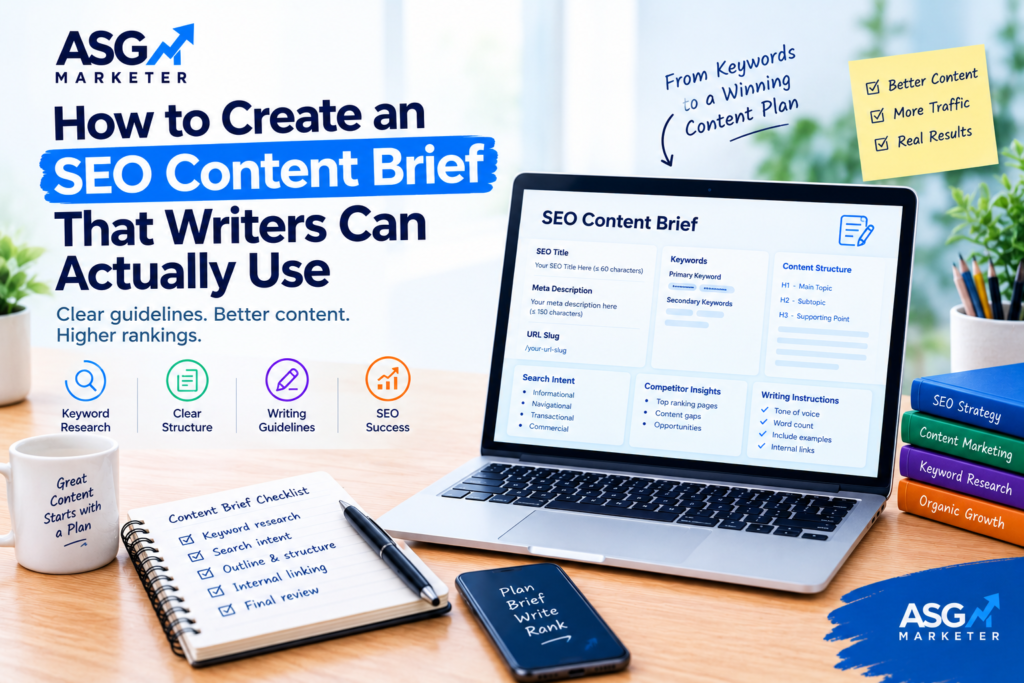

How to Create an SEO Content Brief That Writers Can Actually Use
A content brief should make writing easier, not turn it into a guessing game. Yet many SEO briefs are little more than a keyword, a suggested word count and a list of headings copied from competing pages. Writers receive instructions, but are still left to work out what the reader needs, which points matter and how the article should support the business.
A useful SEO content brief connects search research with a clear editorial direction. It explains the audience, the purpose of the page, the intent behind the target query and the information the finished content needs to cover. It also gives writers enough freedom to produce something helpful rather than forcing them to follow a rigid formula.
This guide explains how to create a practical content brief that helps SEO teams, editors and writers work towards the same result.
What Is an SEO Content Brief?
An SEO content brief is a document that gives a writer the information needed to create a page for a defined audience and search purpose. It usually includes the target topic, primary and supporting keywords, search intent, audience details, recommended structure, important questions, internal links and editorial requirements.
The brief is not the finished article. It is a shared plan that sets direction before drafting begins. The writer should understand what the page needs to achieve, while still having room to organise the information in a natural and engaging way.
1. Start With the Purpose of the Page
Before researching keywords, define why the content is being created. Is the page intended to attract people who are learning about a problem, compare available solutions, evaluate providers or take a specific action? A clear purpose prevents the brief from becoming a collection of loosely related search terms.
Write one short objective that describes the intended reader and the value the page should provide. For example: “Help small business owners understand the information they should prepare before requesting an SEO audit.” This gives the writer a practical direction and helps the editor judge whether the finished article is on track.
Also decide how the page fits into the wider website. It might support a service page, answer a question raised by existing customers or cover a topic that is missing from the current content library.
2. Understand Search Intent Before Selecting Keywords
A keyword can look attractive in a research tool but still be unsuitable for the page you want to publish. Review the search results for the main query and look at the type of content Google is showing. Are the results guides, comparison pages, product listings, service pages or tools?
The format and angle of current results provide useful clues about what searchers expect. They are not instructions to copy competitors. Use them to understand the task a reader is trying to complete, then identify how your page can answer it more clearly or completely.
- Informational intent: the reader wants to understand a topic or solve a problem.
- Commercial investigation: the reader is comparing options before making a decision.
- Transactional intent: the reader is ready to buy, book or take another action.
- Navigational intent: the reader is looking for a particular brand, website or destination.
Some searches have mixed intent. If results show several content formats, note that in the brief and choose the angle that best supports your audience and business objective.
3. Choose One Primary Keyword and Relevant Supporting Terms
Give the writer one clear primary keyword that represents the central topic. Add supporting terms only when they help explain the subject, cover a related subtopic or reflect a genuine way people search.
Avoid giving writers a long, unfiltered keyword export. A list of dozens of phrases can encourage awkward repetition and make the article lose focus. Group related terms by meaning and explain where they fit naturally.
For each important keyword or topic, record its role rather than simply listing it. Identify the main phrase, close variations, questions worth answering and related concepts that need coverage. Search volume can help with prioritisation, but relevance and intent should guide the final selection.
4. Analyse Competitor Pages for Gaps, Not for Copying
Review a small set of pages that rank for the target query. Look at the questions they answer, the structure they use, the level of detail and the practical examples they include. Note where several competitors provide similar information and where useful details appear to be missing.
A competitor review should help identify the standard a page needs to meet and the opportunity to add something more useful. It should never become an instruction to reproduce another website’s headings, wording or unique examples.
- Which reader questions appear across several relevant pages?
- Are there important steps, limitations or examples that competitors overlook?
- Does the content explain the topic clearly for the intended audience?
- Can your brand add original experience, practical advice or a clearer process?
- Are the ranking pages current and relevant to the search taking place today?
5. Build an Outline Around the Reader’s Questions
Create a logical H1, H2 and, where needed, H3 structure. The outline should guide the reader from the main question towards a useful answer. Avoid adding headings simply to include more keywords.
A practical structure often introduces the problem, explains the key concepts, walks through the process, addresses common mistakes and finishes with a clear next step. The exact order should depend on the subject and search intent.
Under each heading, add a short note explaining what the section must cover. This is more useful than giving the writer a heading with no context. Do not force an exact word count for every section. Give a sensible overall range only when it helps the writer understand the expected depth. The article should be as long as the subject requires, without padding.
6. Include Questions People Need Answered
Questions from search results, customer conversations, sales calls and support requests can reveal what readers still need to know. Add the most relevant questions to the brief and decide whether each one belongs in the main article or an FAQ section.
Do not add every question you find. Keep the list focused on the page’s purpose and avoid repeating the same answer under several headings. The writer should answer questions directly and provide enough explanation to make the response useful.
If the article supports a service or product decision, include questions about suitability, process, cost factors, limitations or what happens next where they genuinely apply.
7. Plan Internal Links Before the Article Is Written
Internal links should help readers move naturally between related pages. Identify relevant service pages, supporting guides and useful resources before drafting so the writer can include links in meaningful places.
For each suggested link, provide the destination URL and explain the context in which it should be used. Avoid giving a list of URLs with instructions to add them all at the end. Anchor text should describe the destination naturally and should not be forced to match an exact keyword.
For example, an article explaining how to assess website performance could link to the SEO audit service when discussing a deeper technical and content review.
A wider content plan can also connect supporting articles to relevant service pages. Explore the ASG Marketer services to understand which commercial pages may be relevant.
8. Give Clear Editorial and On-Page Instructions
The brief should explain how the content needs to read and what must be checked before publication. Keep these instructions specific to the brand and audience.
- Use clear, natural language and explain specialist terms where needed.
- Write for the reader first; do not repeat keywords unnaturally.
- Use descriptive headings that accurately reflect each section.
- Include practical examples where they make an explanation clearer.
- Avoid unsupported statistics, invented case studies and unverified claims.
- Use the agreed spelling, tone and style for the target market.
- Add a relevant call to action without turning the article into a sales pitch.
- Check facts, links, grammar and consistency before submission.
Include any required brand terminology, compliance notes or claims that need approval. If the article requires original data, expert comments or product details, identify who will provide them rather than expecting the writer to invent information.
9. Define What a Finished Draft Must Include
A clear delivery checklist prevents avoidable back-and-forth between the writer and editor. Specify the required items before the work starts.
- One clear H1 and a logical H2/H3 outline.
- A suggested URL slug, meta title and meta description.
- Primary keyword and relevant supporting topics used naturally.
- Useful examples and answers to the priority reader questions.
- Relevant internal links with descriptive anchor text.
- Sources for factual claims that require verification.
- A conclusion that reflects the article’s purpose and next step.
- An FAQ section only when it adds value and avoids repetition.
The final review should assess usefulness, accuracy, clarity and alignment with search intent. Do not judge quality only by keyword frequency or whether every suggested heading was used word for word.
A Simple SEO Content Brief Template
Use the following fields as a starting point. Adapt them to the complexity of the topic rather than making every brief unnecessarily long.
- Working title and content type.
- Target audience and reader problem.
- Purpose of the page and desired next action.
- Primary keyword and supporting topics.
- Search intent and notes from the current search results.
- Competitor pages reviewed and content gaps identified.
- Recommended H1/H2/H3 outline with notes for each section.
- Priority questions to answer.
- Relevant internal links and suggested placement.
- Tone, style, factual and brand requirements.
- Suggested metadata and URL slug.
- Final editorial and SEO quality checks.
Common SEO Content Brief Mistakes
- Choosing keywords before understanding the audience and search intent.
- Sending writers a large keyword list without explaining priorities.
- Copying competitor headings instead of identifying reader needs.
- Setting arbitrary word counts that encourage unnecessary filler.
- Adding internal links without considering their relevance to the paragraph.
- Overloading the brief with instructions that restrict natural writing.
- Leaving facts, examples and expert input undefined.
- Measuring success only by rankings instead of useful traffic and business outcomes.
How to Measure Whether Your Content Brief Is Working
A strong brief should make the content process clearer and improve the quality of the finished page. Review performance after publication, but also collect feedback from writers and editors.
Track whether the page attracts relevant organic impressions and clicks, whether it earns visibility for the intended topic, and whether visitors take meaningful next steps. Review engagement and conversions in the context of the page’s purpose. A guide designed to educate may support a later enquiry rather than generate a lead on the first visit.
Also look at production quality: how often does the draft need major restructuring, are important questions missed, and do writers understand the intended audience? Use these observations to improve future briefs. For larger content programmes, explore ASG Marketer’s SEO automation service for scalable workflows and repeatable checks.
Conclusion
An effective SEO content brief gives writers more than keywords and headings. It explains who the page is for, what the reader wants to achieve, why the topic matters and how the finished content should help. Search intent, competitor research, a useful outline, relevant internal links and clear editorial guidance all contribute to a stronger result.
Keep the brief focused, practical and easy to follow. Give writers enough direction to stay aligned with the SEO strategy, but enough flexibility to create genuinely helpful content. When SEO teams and writers share the same understanding of the page’s purpose, the result is more likely to serve readers and support the wider website.
Frequently Asked Questions
What should an SEO content brief include?
It should include the page objective, target audience, search intent, primary keyword, supporting topics, competitor insights, recommended outline, reader questions, internal links, metadata and editorial requirements.
How long should an SEO content brief be?
There is no fixed length. A focused article may need only a concise brief, while a complex technical or commercial topic may require more research and detailed section notes. Include what the writer needs, not extra instructions for their own sake.
Should writers follow SEO content briefs exactly?
Writers should follow the brief’s objective, audience, search intent and essential coverage. They can improve the structure or wording when doing so makes the content clearer, provided the agreed purpose is maintained.
How many keywords should be included in a content brief?
Use one primary keyword and a manageable set of relevant supporting terms or concepts. Include only phrases that fit the topic and intent naturally; a long keyword list can make writing less focused.
Do SEO content briefs guarantee higher rankings?
No. A content brief improves planning and alignment, but rankings also depend on competition, technical accessibility, authority, content quality and many other factors. It helps create a stronger page; it cannot guarantee a search position.