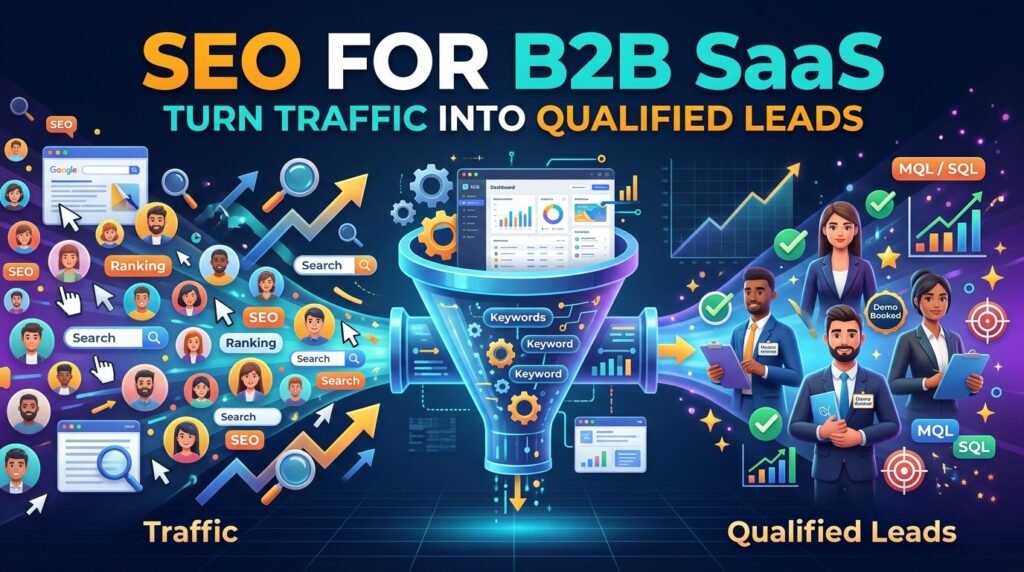

Getting traffic to a website is not the same as generating business.
Many B2B SaaS companies invest in SEO, publish blog posts and target competitive keywords, yet struggle to turn organic visitors into qualified leads. Their websites may receive impressions and clicks, but potential customers are not booking demonstrations, requesting consultations or exploring their products.
The problem is often not a lack of content. It is a lack of alignment between SEO strategy and the buyer journey.
B2B customers rarely make purchasing decisions after reading one article. They research problems, compare software solutions, evaluate providers and look for evidence before committing to a product or service.
This creates an opportunity for SaaS companies to build an SEO strategy that supports customers throughout their decision-making process.
In this guide, we will explore how B2B SaaS businesses can use keyword research, search intent, content planning, technical SEO and conversion optimisation to attract relevant visitors and turn organic search into a consistent source of qualified leads.
Why B2B SaaS SEO Requires a Different Approach
Traditional SEO strategies often focus heavily on traffic growth and keyword rankings. While these metrics are important, they do not always reflect the quality of visitors or their likelihood of becoming customers.
B2B SaaS purchasing decisions usually involve several stages:
- A potential customer identifies a business problem.
- They research possible solutions.
- They compare available software and service providers.
- They evaluate features, pricing and reliability.
- They contact shortlisted companies or request a product demonstration.
Your SEO strategy should support these stages rather than targeting informational searches without considering what happens next.
For example, someone searching for “what is project management software” may be exploring a general concept. Someone searching for “best project management software for remote teams” is likely comparing solutions.
Both searches can be valuable, but they require different landing pages and content approaches.
A successful SEO strategy connects search visibility with the actual needs of potential customers.
1. Understand Your SaaS Buyer’s Search Journey
Before creating content, understand how your ideal customers search for information.
Different searches indicate different levels of awareness and purchasing intent.
Problem-Aware Searches
At this stage, potential customers understand that something is not working but may not know which solution they need.
Examples include:
- How to reduce manual business processes.
- Why sales teams struggle with lead management.
- How to improve employee productivity.
- Ways to manage customer information more efficiently.
These searches are useful opportunities for educational content.
Create practical guides that explain the problem, discuss possible approaches and help readers understand their options.
Solution-Aware Searches
At this stage, users understand the type of solution they need and are researching available approaches.
Examples include:
- Benefits of CRM software for small businesses.
- Cloud-based project management solutions.
- Automated lead generation tools.
- Business workflow automation software.
Your content should explain how different solutions work and which business requirements they address.
Comparison articles, solution guides and detailed feature explanations can be effective formats.
Product-Aware Searches
These users are evaluating specific products, providers or features.
Examples include:
- CRM software with automated reporting.
- Best SaaS platforms for enterprise teams.
- Software comparison for growing businesses.
- Alternatives to a particular software platform.
Create comparison pages, alternatives articles, product landing pages and detailed feature pages.
Purchase-Intent Searches
These searches often indicate stronger commercial intent.
Examples include:
- Book a software demonstration.
- SaaS pricing plans.
- Enterprise software consultation.
- CRM implementation services.
Your landing pages should make the next step clear through relevant calls to action, transparent information and accessible contact options.
2. Build a Keyword Strategy Around Business Intent
Keyword research should go beyond finding phrases with high search volumes.
For B2B SaaS websites, a keyword with relatively low search volume can still be valuable if it attracts decision-makers who are actively looking for a solution.
Start by identifying the main products, services and problems your business addresses.
Then organise keywords into relevant groups.
| Keyword Category | Example | Recommended Content |
|---|---|---|
| Informational | What is workflow automation? | Educational blog. |
| Problem-focused | How to reduce manual data entry | Problem-solving guide. |
| Commercial | Best workflow automation software | Comparison article. |
| Feature-focused | Workflow automation with CRM integration | Feature landing page. |
| Transactional | Enterprise workflow automation platform | Product or service page. |
Do not target every keyword on a separate page automatically.
Review search intent and identify keywords that can be covered naturally by one useful page. This helps prevent unnecessary content duplication and keyword cannibalisation.
For a stronger keyword and competitor strategy, start with a structured SEO audit to identify existing content gaps, keyword opportunities and pages that need improvement.
3. Create Content That Supports Every Buying Stage
A B2B SaaS content strategy should not depend entirely on blog publishing.
Different content formats help potential customers evaluate solutions at different stages.
Educational Blog Posts
Educational articles attract users researching a business problem or industry topic.
For example, a SaaS company offering customer relationship management software could publish content about managing customer data, improving sales processes and organising customer communication.
The purpose is to provide useful information while introducing relevant solutions naturally.
Comparison Articles
Comparison content helps buyers evaluate different options.
Examples include:
- Software A vs Software B.
- Cloud-based software vs on-premise solutions.
- Free tools vs paid business platforms.
- Different software solutions for growing companies.
These articles should be balanced, detailed and based on verifiable information.
Avoid presenting unsupported claims about competitors. Buyers need useful comparisons, not exaggerated marketing statements.
Feature and Solution Pages
Feature pages explain how specific product capabilities solve customer problems.
For example, a business automation platform may have separate pages for reporting, workflow management, integrations and team collaboration.
Each page should explain:
- What the feature does.
- Which problem it solves.
- Who benefits from it.
- How it works.
- Which related features support the solution.
Case Studies and Customer Stories
B2B buyers often want evidence before making a purchasing decision.
Case studies can demonstrate how a product or service helped address a specific challenge.
Where permission and reliable data are available, include the original problem, implementation process, measurable results and customer feedback.
Never invent customer results or performance statistics.
4. Build a Strong Internal Linking Structure
Internal linking helps search engines discover related pages and helps visitors move through your website.
For SaaS websites, internal links should connect educational content with relevant commercial pages.
For example, an article about business workflow challenges could link to a relevant automation solution page. A comparison article could link to a product feature page or demonstration page.
A practical internal linking structure may look like this:
- Educational blogs link to relevant solution pages.
- Feature pages link to related features and integrations.
- Comparison articles link to product or service pages.
- Case studies link to the relevant product or service.
- Important landing pages receive relevant links from supporting content.
Use descriptive anchor text that explains what visitors will find after clicking.
Avoid adding irrelevant links simply to increase the number of internal links on a page.
A well-organised website structure also makes it easier for search engines to understand the relationship between different sections.
5. Optimise SaaS Landing Pages for Search and Conversions
A SaaS landing page should do more than contain target keywords.
It needs to explain the product clearly and help visitors understand whether it meets their requirements.
Write Clear and Relevant Page Titles
Your page title should communicate the main subject of the page and reflect the search intent.
Avoid generic titles that fail to explain what the product or service offers.
Create Helpful Page Headings
Use a clear H1 heading followed by logical H2 and H3 sections.
Each section should answer a specific question or explain an important aspect of the solution.
Explain Product Benefits Clearly
Do not focus only on technical features.
Explain how those features help customers solve business problems.
For example, instead of simply stating that a platform offers automated reporting, explain how automated reports can reduce repetitive manual work and improve access to business information.
Add Relevant Calls to Action
Every important landing page should guide visitors towards a logical next step.
Depending on the business model, this could include:
- Request a demonstration.
- Book a consultation.
- Start a free trial.
- View pricing.
- Contact the sales team.
Keep calls to action relevant to the user’s stage in the buying journey.
6. Improve Technical SEO for a Better Website Experience
Even strong content can struggle to perform when a website has technical problems.
B2B SaaS websites often contain multiple landing pages, product sections, resource libraries and dynamically generated URLs. As the website grows, maintaining a clean technical structure becomes increasingly important.
Focus on the following areas:
Website Crawlability
Make sure important pages can be discovered through internal links and are not accidentally blocked from crawling.
Indexing
Review whether valuable landing pages are eligible for indexing. Check for incorrect noindex directives, canonical issues and unnecessary duplicate URLs.
Website Speed
Improve page loading performance, optimise images and reduce unnecessary scripts where possible.
Mobile Experience
Make sure product pages, forms, navigation and calls to action work properly across mobile devices.
Structured Data
Use relevant structured data where appropriate and ensure that markup accurately reflects visible page content.
Technical improvements should be based on evidence rather than automatically implementing every recommendation generated by an SEO tool.
For businesses looking to identify technical barriers, ASG Marketer provides SEO audit services covering technical health, on-page performance and website opportunities.
7. Use Competitor Research to Find Content Opportunities
Competitor research helps SaaS businesses understand what is already performing in their industry.
Instead of copying competitor content, analyse how competing websites address customer needs.
Look at:
- Keywords driving traffic to competitor pages.
- Product and feature landing pages.
- Comparison articles.
- Frequently covered customer questions.
- Content gaps on your own website.
- Internal linking patterns.
- Search intent behind competing pages.
For example, if several competitors have dedicated pages explaining integrations but your website only mentions integrations briefly, this could be a useful content opportunity.
However, create a separate page only when there is enough unique information and genuine search demand to justify it.
Your objective should be to provide a more useful experience, not simply publish more pages than competitors.
8. Measure SEO Performance Beyond Organic Traffic
Organic traffic is an important metric, but it should not be the only measure of success for a B2B SaaS business.
Track metrics that help connect SEO activities with business outcomes.
| SEO Metric | What It Helps Measure |
|---|---|
| Organic clicks | Visits generated through search results. |
| Keyword visibility | How frequently important pages appear for relevant searches. |
| Landing page engagement | How visitors interact with important pages. |
| Demo requests | Potential customers showing interest in the product. |
| Contact form submissions | Enquiries generated through organic visits. |
| Qualified leads | Prospects matching the business’s target customer profile. |
| Organic-assisted conversions | Conversions where organic search contributed to the customer journey. |
Google Search Console can help you monitor search queries, impressions and clicks.
Google Analytics 4 can help you understand website interactions and conversion events.
Where possible, connect website activity with CRM data to understand whether organic leads progress into meaningful sales opportunities.
This provides a more complete picture of SEO performance than rankings alone.
9. Avoid Common B2B SaaS SEO Mistakes
Even businesses with established SEO strategies can make mistakes that limit organic growth.
Targeting High-Volume Keywords Without Commercial Relevance
A keyword may attract thousands of searches but provide very little value if the audience is unrelated to your product.
Focus on relevance and intent rather than search volume alone.
Publishing Content Without a Clear Purpose
Every article should support a specific audience need or business objective.
Publishing unrelated articles simply to increase content volume can weaken the overall strategy.
Ignoring Product and Feature Pages
Many SaaS businesses invest heavily in blogs while leaving important product pages poorly optimised.
Your commercial pages deserve the same level of keyword research, content optimisation and internal linking.
Overlooking Conversion Tracking
Without accurate conversion tracking, it becomes difficult to understand whether organic search is generating valuable enquiries.
Set up relevant events and regularly review the quality of leads generated through organic traffic.
Neglecting Content Updates
Software products change. Features, integrations, pricing and customer requirements can evolve.
Review important pages regularly and update information when it becomes outdated.
How ASG Marketer Can Help B2B SaaS Businesses
Building a successful B2B SaaS SEO strategy requires more than publishing articles and tracking rankings.
Businesses need a connected approach that brings together keyword research, technical optimisation, content strategy, internal linking and performance measurement.
ASG Marketer helps businesses build SEO systems designed to improve search visibility and support sustainable growth.
Explore our SEO services to understand how technical optimisation, content strategy and other SEO activities can work together.
If your website has technical issues or is struggling to attract relevant organic traffic, our SEO audit services can help identify opportunities and develop a practical improvement roadmap.
For growing businesses that want to reduce repetitive SEO tasks, explore our SEO automation services.
You can also contact ASG Marketer to discuss an SEO strategy aligned with your business objectives.
Conclusion
B2B SaaS SEO should focus on attracting the right audience, not simply increasing the number of website visitors.
A strong strategy begins with understanding the buyer journey, researching commercial keywords and creating content that addresses real business problems.
From there, businesses need relevant internal links, technically sound landing pages, useful product information and accurate conversion tracking.
When these activities work together, organic search can become an important channel for attracting qualified prospects and supporting long-term business growth.
The objective is simple: help potential customers discover your business, understand your solution and take the next step with confidence.
Frequently Asked Questions
1. What is B2B SaaS SEO?
B2B SaaS SEO is the process of improving a software company’s organic search visibility to attract businesses looking for relevant software solutions. It includes keyword research, technical SEO, content optimisation, internal linking and conversion-focused landing pages.
2. Why is SEO important for SaaS companies?
SEO helps SaaS companies reach potential customers when they are researching business problems, comparing solutions or evaluating software providers. It can build long-term organic visibility and generate relevant website enquiries.
3. Which keywords should B2B SaaS companies target?
B2B SaaS companies should target a combination of informational, problem-focused, commercial and transactional keywords. The best opportunities depend on their products, audience, competition and business goals.
4. How often should SaaS companies publish SEO content?
There is no universal publishing frequency. Businesses should focus on creating useful, accurate and relevant content rather than publishing a fixed number of articles without a clear strategy.
5. How can SaaS companies generate leads through SEO?
They can attract relevant visitors through buyer-intent keywords, optimise product and service pages, publish comparison content, build relevant internal links and provide clear calls to action.
6. How long does B2B SaaS SEO take to show results?
SEO timelines vary depending on website authority, competition, technical health, content quality and implementation speed. Some improvements may become visible earlier, while sustainable organic growth generally requires consistent work over time.
7. What is the difference between B2B SEO and traditional SEO?
B2B SEO often involves longer buying journeys, multiple decision-makers and more detailed product evaluation. Its content strategy therefore needs to support different stages of research and purchasing rather than focusing only on broad traffic growth.