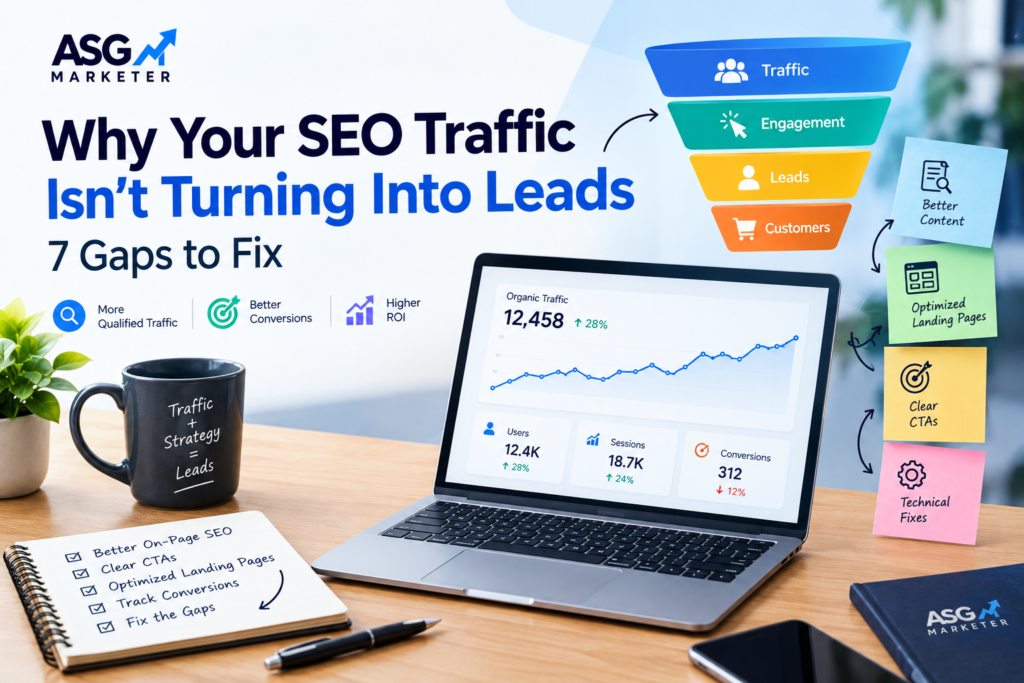

It feels like progress when organic traffic starts going up. More people are finding your pages, Search Console is showing new clicks, and the SEO report finally looks healthier. Then you check the enquiries inbox and realise something is missing: the traffic is arriving, but the leads are not.
This is more common than many businesses expect. Search visibility is useful, but traffic on its own does not tell you whether the right people are landing on your website or whether the page gives them a clear reason to take the next step.
If your website attracts visitors but generates very few enquiries, the answer is not always to publish more content or chase higher rankings. Sometimes the problem sits between the search query and the page, or between the page and the action you want someone to take. Here is how to investigate those gaps without guessing.
1. The Page Attracts the Wrong Search Intent
Imagine someone searches for “what is technical SEO” and lands on a service page that immediately asks them to book a consultation. They may be researching a concept, not looking to hire an agency yet. The page might rank well and still struggle to generate leads because it is answering a different question from the one the visitor had.
Check the queries bringing people to each landing page. Are they informational, comparative or clearly commercial? Then compare those queries with the page’s content and call to action. An informational article can guide readers towards a relevant service, but it should first answer their question properly. A service page should explain what is offered, who it helps and what happens next.
Search intent is not a small keyword detail. It shapes what people expect to see when they click. If the page and the query do not match, more traffic may simply mean more visitors leaving without taking action.
2. Your Landing Page Does Not Make the Offer Clear
A visitor should not have to work hard to understand what your business does. If the headline is vague, the service description is buried, or the page uses broad claims without explaining the actual deliverable, people may leave even when the service could be right for them.
Read the page as if you have never heard of the company. Within a few seconds, can you explain what is being offered, who it is for and what problem it solves? Add specific details where they help: the type of work included, the process, the expected deliverables and any limitations. Clear language often does more for trust than another paragraph of marketing adjectives.
3. The Call to Action Feels Like Too Big a Commitment
“Contact us” can work, but it is not always the best next step for every visitor. Someone who is still comparing options may not be ready to start a sales conversation. Explain what they will get from a consultation, what information to prepare or what happens after they submit the form.
Make the action visible and specific. If the next step is a consultation, say what the conversation is for. If the form requests a phone number, company details and a long description before the visitor understands the value, consider whether every field is necessary at that stage.
Avoid adding multiple competing calls to action that pull the reader in different directions. Give each page one main purpose, with a secondary option only where it genuinely helps.
4. The Page Does Not Build Enough Trust
People rarely enquire simply because a website says it is the best. They look for signs that the business understands their problem and can deliver what it promises. Missing service details, vague testimonials, unexplained claims or a lack of useful examples can create doubt at the exact moment someone is deciding whether to get in touch.
Use evidence that you can stand behind. Explain your process, show relevant experience, describe what a client can expect and make contact information easy to find. If you publish case studies, include the starting situation, the work completed and the outcome only when the details are accurate and approved. Never invent results to make a page appear more convincing.
A structured review can help identify whether the issue is content, technical performance, site structure or conversion friction. ASG Marketer’s forensic SEO audit service looks at these areas together, rather than treating rankings as the only measure of success.
5. Mobile Visitors Have a Frustrating Experience
A page can look fine on a desktop monitor and still be difficult to use on a phone. Forms may be awkward to complete, buttons can be hard to tap, important details may sit too far down the page, and intrusive pop-ups can interrupt the visit.
Test your highest-value landing pages on a real mobile device. Try to complete the same action a potential customer would take. Check the form, phone links, navigation, page speed and whether the main offer is easy to understand without excessive scrolling. Fixing a small usability problem can remove unnecessary friction from the enquiry process.
Do not assume every low-converting page has a design problem, though. Check analytics and user behaviour first, then make changes that address the actual issue.
6. You Are Measuring Visits, Not Business Outcomes
Organic sessions and keyword rankings are useful diagnostic metrics, but they do not tell the whole story. A page with fewer visits may generate more qualified enquiries than a popular blog post. If reporting stops at traffic, it becomes difficult to know which SEO work is helping the business.
Track meaningful actions where possible: completed enquiry forms, booked consultations, qualified leads, purchases or other outcomes relevant to your business. Make sure analytics events are configured correctly and test them periodically. If leads are qualified later in a CRM, connect that information to the landing page or source when your systems allow it.
Attribution is rarely perfect. A customer may discover a business through one page and return later through another channel. Be transparent about what your data can prove, and use several signals rather than crediting every conversion to the last click.
7. SEO and Conversion Work Are Being Managed Separately
SEO teams may focus on rankings and content while the website team focuses on design, and the sales team sees only the leads that arrive. If these groups do not share what they are learning, useful information gets lost. Search queries can reveal customer concerns, sales calls can expose objections, and form data can show where the process becomes difficult.
Bring those observations together. Use search data to understand what people want, analytics to see what they do on the page, and sales feedback to understand whether enquiries are a good fit. Then prioritise improvements by likely business impact rather than by how easy they are to report.
For teams managing many pages or frequent SEO changes, SEO automation workflows can help monitor technical issues and content performance. Automation is most useful for surfacing patterns and reducing repetitive checks; deciding what to change still requires context and judgement.
A Practical Way to Diagnose the Problem
Instead of redesigning the whole website, choose one important landing page and work through a short review:
- Identify the queries and pages bringing in organic visitors.
- Check whether the search intent matches the page’s purpose.
- Review the headline, offer, supporting evidence and main call to action.
- Test the page and enquiry process on mobile.
- Confirm that form submissions and other conversion events are tracked correctly.
- Compare lead quality as well as conversion volume.
- Make one or two focused changes, record the date and review the results.
This process will not guarantee an immediate increase in leads, but it gives you a clearer way to find the obstacle. It also helps avoid changing several things at once and then having no idea which change made a difference.
Frequently Asked Questions
Why is my website getting traffic but no leads?
Common causes include mismatched search intent, an unclear offer, weak trust signals, a difficult enquiry process, mobile usability problems or incorrect conversion tracking. Review the landing page and the queries bringing visitors before making major changes.
Should I focus on rankings or conversion rate first?
It depends on the problem. If the page attracts very little relevant traffic, improve visibility and intent alignment. If relevant visitors arrive but rarely take action, investigate the landing page, offer, trust and user experience.
How can I improve organic traffic conversion rate?
Start by matching content to user intent, making the offer clear, reducing unnecessary form friction, adding credible evidence and measuring completed actions accurately. Test changes on important pages and compare results over a reasonable period.
Can SEO audits identify conversion problems?
A thorough audit can reveal issues such as intent mismatch, weak landing-page structure, usability barriers, tracking gaps and technical problems. It should prioritise findings by business impact rather than provide a list of errors without context.
Does more organic traffic always mean more revenue?
No. Traffic is valuable when it reaches the right audience and supports meaningful actions. Relevant visits, qualified leads, conversion rates and revenue provide a more complete picture than sessions alone.
Conclusion
When SEO traffic is not turning into leads, it is tempting to assume the website needs more keywords, more blogs or more backlinks. Those may be useful in some situations, but they will not solve a page that attracts the wrong audience or makes it difficult for interested visitors to take action.
Start with the evidence. Check the queries, review the landing page, test the enquiry journey and measure the actions that matter to the business. A few well-chosen improvements can be more useful than a large redesign based on assumptions.
If your organic performance is growing but the business impact remains unclear, explore ASG Marketer’s SEO services or get in touch through the contact page to discuss the gaps you are seeing.