
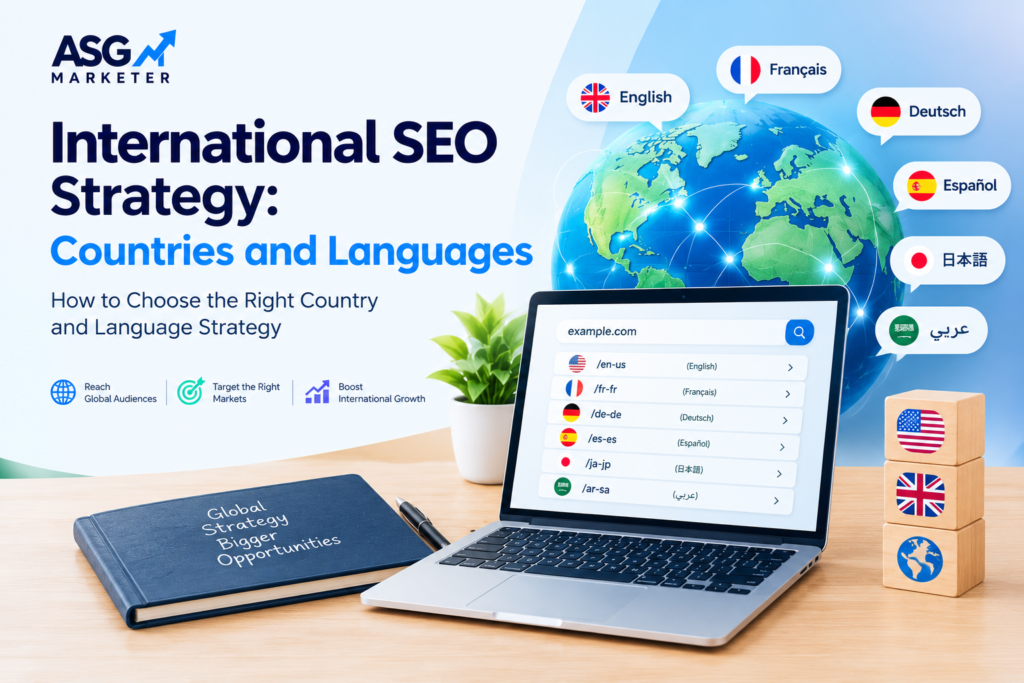

Expanding into another country can open up a valuable source of customers, but simply translating your website rarely delivers the results businesses expect. People in different markets search in different ways, compare different options, and may need different information before they feel confident enough to buy. Search engines also need clear signals to understand which version of a page is intended for each audience.
An effective international SEO strategy connects market research, local search behaviour, website structure, technical signals, and useful content. Instead of trying to rank everywhere at once, a business can prioritise the markets where demand and commercial potential are strongest, then build a realistic plan for growth.
This guide explains how to select target countries and languages, organise your website, avoid common technical mistakes, and measure whether international SEO is contributing to business goals.
1. Start with Market Demand, Not Assumptions
A country may look attractive because it has a large population or a familiar language, but those factors alone do not prove that it is the right market. Begin by checking whether people in that location search for the products or services you offer and whether your business can serve them competitively.
Research the opportunity
- Search demand: estimate the volume and seasonality of relevant queries in each potential market.
- Search intent: check whether users are looking to learn, compare providers, request a quote, or purchase immediately.
- Competition: review the websites currently ranking for your important terms and assess how established they are.
- Commercial fit: consider shipping, payment methods, local regulations, customer support, and delivery times.
- Existing signals: review analytics and Search Console data for countries already sending impressions, clicks, enquiries, or sales.
Create a shortlist rather than launching multiple market versions at once. A smaller number of well-supported markets is usually easier to research, localise, and maintain than a large set of thin country pages.
2. Decide Whether You Need a New Country, a New Language, or Both
Country targeting and language targeting are related, but they are not the same. One language can be used across several countries, while one country may have several commonly used languages. Your site should reflect how customers actually search and how your business serves them.
When country-specific content makes sense
Create country-specific pages when the offer, pricing, availability, regulations, delivery, testimonials, or customer expectations genuinely differ by market. For example, a service provider may need different case studies and contact details for the UK and UAE even if both pages are written in English.
When language-specific content makes sense
A language version is useful when you can provide a genuinely helpful experience in that language. This means more than translating headings: product details, examples, calls to action, customer support information, and terminology should feel natural to the intended audience.
Avoid creating a separate URL for every possible country-language combination unless there is a real audience and a distinct, useful page to support it. Empty or nearly identical pages can create maintenance work without giving visitors a reason to choose your business.
3. Choose an International URL Structure
Your URL structure helps people and search engines identify the different versions of your website. There is no single structure that suits every business; the right choice depends on resources, branding, technical requirements, and how independently each market will operate.
Common options
- Country-code top-level domains (ccTLDs), such as example.co.uk, can provide a clear country association but require separate domain management and authority-building efforts.
- Subdomains, such as uk.example.com, can separate regional sites while keeping them under the same main domain name.
- Subdirectories, such as example.com/uk/, keep country or language sections within one domain and are often simpler to manage centrally.
Choose a structure you can maintain consistently. Make sure every version has a clear purpose, stable URLs, correct internal links, and a navigation experience that helps users reach the appropriate market.
4. Implement Hreflang Carefully
Hreflang annotations help search engines understand the relationship between alternate language or regional versions of a page. They can help the right version appear for the right audience, but they do not automatically translate content or guarantee rankings in a particular country.
Practical hreflang checks
- Use valid language and, where relevant, region codes.
- Make sure each alternate page points to itself and to the other relevant versions.
- Ensure the referenced URLs are accessible and return the intended page rather than an error or redirect chain.
- Keep hreflang annotations consistent across HTML, XML sitemaps, or HTTP headers if you use those methods.
- Use x-default where appropriate for a language or country selector page that serves as a general fallback.
A common problem is adding hreflang tags that point to pages which do not reciprocate, or mixing URLs from staging and production environments. Include hreflang validation in your technical QA process whenever you launch or change international pages.
5. Localise the Content Instead of Translating Word for Word
Direct translation can preserve the meaning of a sentence while missing the way local customers actually describe a problem or choose a supplier. International keyword research should therefore be carried out for each priority market, even when the language is shared.
What meaningful localisation includes
- Use local keyword variations and terminology, based on real search behaviour.
- Adapt spelling, measurements, currencies, dates, and examples where they matter.
- Show relevant delivery, service coverage, warranties, returns, or local contact information.
- Use testimonials, case studies, and proof points that are credible for the audience.
- Review calls to action so they match local buying expectations and the next step your business can fulfil.
Localisation does not mean changing every sentence simply to make it different. Keep useful information consistent where the offer is the same, and adapt the parts that genuinely affect relevance, trust, or conversion.
6. Build Internal Links That Support Each Market
International pages should not sit in an isolated folder with no clear route from the rest of the site. Link to relevant regional pages from navigation, service pages, guides, and other useful content. Use descriptive anchor text that tells visitors what they will find.
Where a page has equivalent versions in other languages or regions, provide a clear language or country switcher. Avoid automatically forcing every visitor to a regional version based only on IP address; users may be travelling, using a VPN, or prefer another language. Offer a clear choice and remember their selection when practical.
A structured review can reveal whether market pages are discoverable and technically consistent. ASG Marketer explains its approach to identifying site-wide issues through its SEO audit service.
7. Make Sure Technical SEO Supports International Growth
Before investing heavily in new content, check that search engines can crawl and index the pages you are creating. International SEO can become complicated when multiple templates, language switches, canonical tags, redirects, and sitemap rules interact.
- Use self-referencing canonical tags on pages that should be indexed independently.
- Do not canonicalise every regional page to one default version if each page is intended to serve a distinct audience.
- Include indexable, preferred URLs in the relevant XML sitemap and keep sitemap entries up to date.
- Check that robots.txt rules and noindex directives are not blocking important market pages.
- Review page speed, mobile usability, structured data, and broken links across every template and locale.
- Test redirects carefully, especially when changing domains, URL structures, or language paths.
For a growing site, repeatable checks can reduce the chance that a template change breaks hundreds of pages. Learn more about scalable processes on the SEO automation service page.
8. Measure Performance by Market
Combining every country and language into one report can hide important differences. Track performance separately for each priority market so you can see where demand is growing, where technical problems remain, and whether visits are producing meaningful business outcomes.
- Search visibility: impressions, clicks, and query coverage by country and page.
- Landing-page performance: organic entrances, engagement, and next-step behaviour for each locale.
- Conversions: qualified leads, purchases, quote requests, or other outcomes tied to business goals.
- Technical health: indexation, hreflang errors, crawl issues, redirects, and canonical consistency.
- Commercial value: conversion rate, revenue or lead quality, and the cost of serving each market.
Set a baseline before launch and review the data at regular intervals. A market that generates fewer visits but more qualified enquiries may be more valuable than a market with high traffic and little commercial impact.
9. Common International SEO Mistakes to Avoid
- Launching many country pages before confirming demand or operational capability.
- Publishing machine-translated pages without human review or local keyword research.
- Using incorrect or incomplete hreflang annotations.
- Sending every international visitor to one version automatically with no easy way to switch.
- Duplicating the same content across country pages without adding market-specific value.
- Forgetting to update internal links, canonical tags, XML sitemaps, and redirects after a site migration.
- Measuring success only through rankings or traffic instead of leads, sales, and market-level performance.
A Practical International SEO Launch Checklist
- Prioritise markets using demand, competition, commercial fit, and existing data.
- Confirm the language and country combinations your business can support.
- Select a URL structure that fits your resources and long-term plans.
- Research local keywords and adapt content to each audience.
- Implement and validate hreflang, canonical tags, redirects, and XML sitemaps.
- Build clear navigation and internal links between relevant market pages.
- Set up market-level reporting for visibility, conversions, and technical health.
- Review results and expand only when the first markets have a reliable operating process.
Conclusion
International SEO works best when expansion is treated as a business decision supported by search data, not as a translation project. Choose markets where there is meaningful demand, create pages that answer local needs, and make the relationship between each regional version clear to search engines.
Start with a manageable set of priority markets, establish technical quality before scaling, and measure performance in terms of qualified business outcomes. If your website is preparing to expand across borders, explore ASG Marketer’s international SEO services and contact the team to discuss a strategy aligned with your growth goals.
Frequently Asked Questions
What is international SEO?
International SEO helps search engines understand which country or language version of a website is most relevant to different audiences. It combines market research, localisation, URL planning, technical signals, and performance measurement.
Should I use a separate domain for every country?
Not necessarily. Country-code domains, subdomains, and subdirectories can all work. Choose the structure that suits your brand, technical resources, and market plans, then implement it consistently.
What is the difference between international SEO and multilingual SEO?
International SEO focuses on reaching audiences across countries or regions, while multilingual SEO focuses on serving people in different languages. A strategy may need one, the other, or both.
Do I need hreflang tags for every international page?
Hreflang is useful when you have alternate versions of a page for different languages or regional audiences. It should be implemented with valid codes and reciprocal references, and the URLs must be accessible and consistent.
How long does international SEO take to show results?
Timing depends on the site’s existing authority, competition, technical condition, content quality, and the market. Treat the launch as an ongoing process and use early indexation and visibility data to guide improvements rather than expecting a fixed timeline.