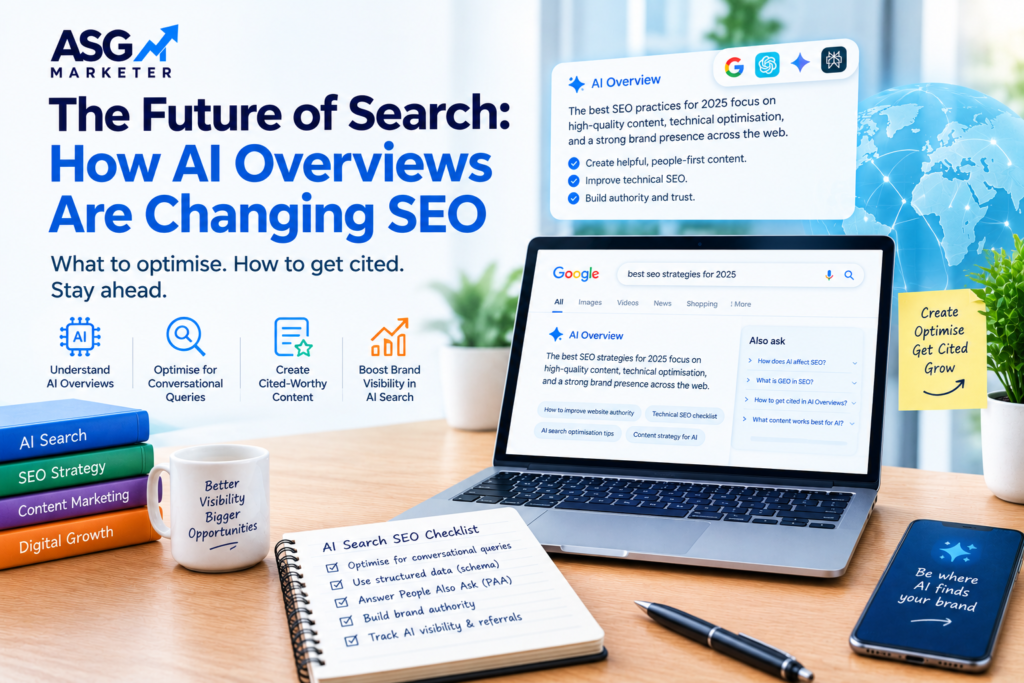

Search is becoming more conversational. Instead of presenting only a list of links, Google can show an AI-generated overview that brings together information from multiple sources and provides links for users who want to explore further. For businesses, this changes how people may discover information, compare options and decide which websites to visit.
It does not mean traditional SEO has stopped mattering. Search engines still need to discover, understand and evaluate useful pages. Strong technical foundations, relevant content, clear site structure and a trustworthy brand remain important. What is changing is the search experience and the range of places where a brand may earn visibility.
This guide explains what AI Overviews mean for SEO and how businesses can prepare their websites without chasing shortcuts or treating AI visibility as a guaranteed outcome.
What Are Google AI Overviews?
AI Overviews are AI-generated summaries that may appear within Google Search for certain queries. They bring together information intended to help users understand a topic and can include links to relevant web pages. Their appearance and format can vary by query, market, device and search experience.
An AI Overview is not the same as a normal organic listing. A page may rank in traditional results without being referenced in an overview, and being referenced does not guarantee a consistent position or amount of traffic. Businesses should therefore measure AI-related visibility alongside, rather than instead of, their wider organic search performance.
1. Search Visibility Is Broader Than a Traditional Ranking
For years, many SEO reports focused heavily on keyword positions and organic clicks. These metrics are still useful, but they do not describe every way a searcher can encounter a brand. A person may see a brand mentioned in an AI-generated summary, follow a source link, refine the query or visit a website later through another route.
This makes it important to look at visibility as a wider journey. Track relevant search impressions, clicks, landing-page engagement, branded searches and conversions. Where reliable reporting is available, record examples of AI Overview appearances and the queries that trigger them. Avoid presenting isolated observations as proof of a stable ranking.
The goal is not simply to appear in more places. It is to be visible for searches that matter to the business and to give people a clear reason to trust and visit the website.
2. Create Pages That Answer Real Questions Clearly
AI-powered search experiences are designed to help users explore questions, so content should address the question directly before moving into supporting detail. Start important pages with a clear explanation of the subject. Use descriptive headings, concise definitions, practical steps and examples that make the information easy to follow.
Avoid writing paragraphs that repeat the same keyword or add general statements without helping the reader. Each section should contribute something useful. If a page covers a complex subject, break it into logical sections so readers can find the answer they need.
- State the main answer or purpose of the page early.
- Use headings that describe the question or task covered in each section.
- Explain specialist terms in plain language.
- Add examples, comparisons or steps when they genuinely clarify the topic.
- Keep important information current and review details that may change.
- Remove repetition and unsupported claims.
3. Add Original Value Instead of Rewriting the Same Answers
Many websites cover the same basic questions. Publishing another page that repeats familiar advice may give readers little reason to choose it. Look for ways to add information that reflects genuine expertise: a clear process, first-hand observations, original analysis, useful examples, transparent limitations or answers to questions customers regularly ask.
For service businesses, this could mean explaining how a project works, what information a client needs to provide, which factors affect the outcome and what a realistic process looks like. For ecommerce sites, it could mean useful product comparisons, sizing guidance, compatibility details or care instructions.
Do not invent case studies, statistics, testimonials or expert credentials to make a page appear authoritative. Specific, verifiable information is more valuable than claims that cannot be supported.
4. Make Your Brand and Sources Easy to Understand
Clear business information helps people understand who is behind a website and what the organisation offers. Keep company details, contact information, service descriptions and author information accurate and consistent. Where appropriate, explain the experience behind specialist content and provide references for factual claims.
When an article relies on research, regulations, technical documentation or statistics, link to the original and reliable source. Distinguish between established facts, professional interpretation and opinion. This improves transparency for readers and gives editors a stronger basis for maintaining the page.
Brand authority is not created by adding a few author bios or logos. It develops through useful work, consistent information, credible references and a website that delivers what it promises.
5. Strengthen Technical SEO and Page Accessibility
Useful content still needs to be accessible. Search engines must be able to crawl important pages, understand their content and process the signals provided by the website. Review technical foundations as part of any AI-search strategy.
- Ensure important pages return the correct status code and are not blocked accidentally.
- Use clear internal links so related pages can be discovered and understood.
- Keep canonical tags and XML sitemaps accurate.
- Make key page content available in a crawlable format.
- Use structured data that accurately describes visible page content.
- Maintain mobile usability, performance and a secure website.
Structured data can help search engines interpret specific page elements, but it does not guarantee inclusion in an AI Overview. Do not add irrelevant schema types or mark up information that users cannot see on the page.
If your site needs a wider technical review, explore ASG Marketer’s SEO audit services to identify crawl, indexation and on-page issues.
6. Build Topic Coverage Across Related Pages
A single article rarely answers every question a potential customer may have. Build a useful group of related pages around the main subject, with each page serving a distinct purpose. A central guide can introduce the topic, while supporting pages explain specific questions, processes or comparisons in greater depth.
Connect these pages with contextual internal links. The anchor text should describe the destination and make sense within the sentence. Avoid creating several near-identical articles that compete for the same search intent. Review existing content before publishing another page on a similar topic.
Plan supporting content around the services your business provides by reviewing the ASG Marketer services and the questions potential customers need answered.
7. Adapt Content for Conversational and Follow-Up Searches
People often search in stages. They may begin with a broad question, then ask about cost, suitability, alternatives, risks or the steps involved. Consider these follow-up questions when planning content, but include them only when they are relevant to the page.
For example, a person researching an SEO audit may later want to know what an audit includes, how long it takes, which issues are prioritised and what happens after the report. A page that explains the process clearly can support a more informed decision than one that only defines the term.
Use customer conversations, sales questions, support requests and search query data to identify genuine information gaps. This keeps content grounded in real needs rather than speculative keyword variations.
8. Measure Performance Without Chasing AI Mentions
AI search reporting is still developing, and visibility can vary between queries and search experiences. Avoid relying on one manual search or a single third-party score to judge the success of an SEO strategy.
Use a balanced measurement approach:
- Monitor organic clicks and impressions for priority topics in Google Search Console.
- Review organic landing-page sessions and meaningful conversions in analytics.
- Track branded search demand and referral sources where data is available.
- Record verified examples of AI Overview appearances for relevant queries.
- Compare performance over time and annotate major website or content changes.
- Evaluate whether the traffic attracted is relevant to the business objective.
Do not promise that a particular optimisation will secure an AI citation. Search features change, and no external provider can guarantee that a page will be selected. Focus on improving the quality, accessibility and usefulness of the website.
Common Mistakes to Avoid
- Assuming AI Overviews make traditional SEO irrelevant.
- Publishing generic AI-written pages without original review or useful detail.
- Repeating keywords unnaturally in an attempt to influence AI results.
- Adding structured data that does not match the visible page content.
- Treating one AI Overview appearance as a permanent placement.
- Ignoring technical SEO, internal links and the overall user experience.
- Making unsupported claims about guaranteed AI rankings or citations.
Conclusion
Google AI Overviews are changing how information can appear in search, but the foundations of effective SEO remain important. Businesses still need accessible websites, useful pages, clear expertise and content that answers the questions their audiences are asking.
The best response is not to chase a secret AI ranking tactic. Review the needs behind important searches, improve the quality of existing pages, add original value, strengthen technical foundations and measure outcomes carefully. A website that consistently helps people is better prepared for a search environment that continues to evolve.
If you want to assess your website’s search foundations and identify practical improvements, visit ASG Marketer or get in touch through the Contact Us page.
Frequently Asked Questions
Do AI Overviews replace traditional SEO?
No. Traditional SEO remains important for helping search engines discover, crawl, understand and rank web pages. AI Overviews add another search experience, so businesses should consider both traditional organic performance and broader visibility.
Can a website guarantee a place in Google AI Overviews?
No. There is no guaranteed method to secure inclusion. Search features and source selection can change, so focus on useful content, technical accessibility and trustworthy information.
Does structured data help a page appear in AI Overviews?
Structured data can help search engines interpret eligible page information, but it does not guarantee an AI Overview appearance. Mark-up should be accurate and match visible content.
Should businesses create separate content for AI search?
Usually, the better starting point is to improve existing content so it answers relevant questions clearly and provides original value. Create a new page only when it serves a distinct user need and search intent.
How can I track AI search visibility?
Combine Search Console and analytics data with careful checks of relevant search queries and referral sources where available. Record observations over time, but do not treat occasional appearances as a stable ranking metric.