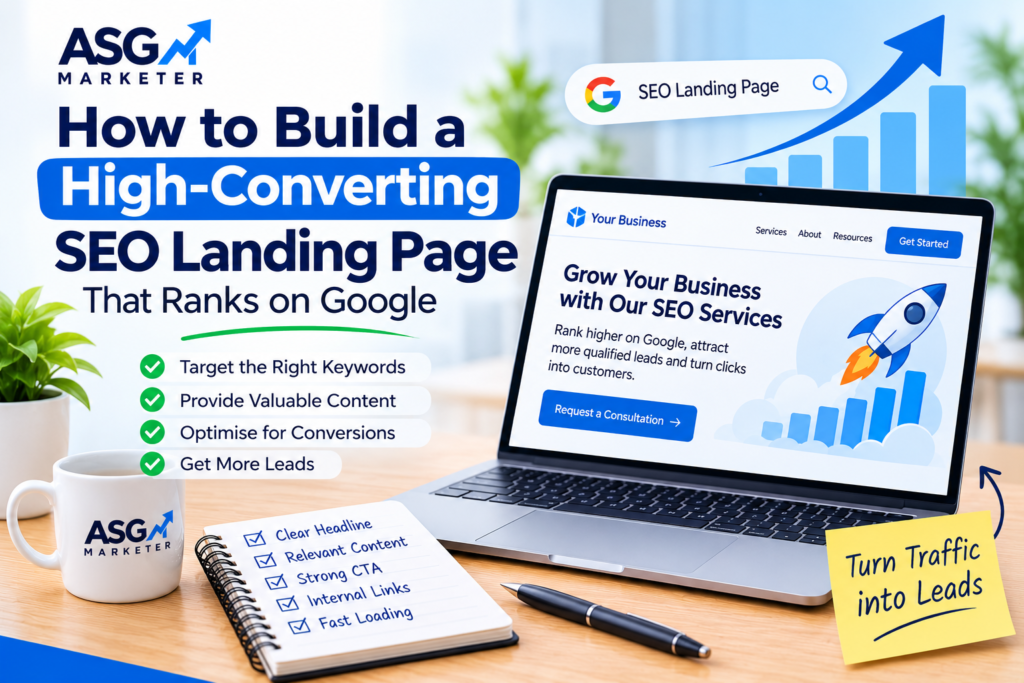

A website can rank on Google, attract organic visitors and still struggle to generate enquiries. One common reason is that its landing pages are not designed to turn visitors into customers.
A landing page has two important responsibilities. It needs to help search engines understand what the page offers, and it needs to give visitors a clear reason to take action.
Some businesses focus entirely on keywords, headings and metadata. Others concentrate on design and calls to action but overlook search intent and technical optimisation. Both approaches can limit performance.
A successful SEO landing page brings these elements together. It targets a relevant search query, answers the visitor’s questions, communicates value and makes the next step easy.
In this guide, we will explain how to build and optimise landing pages that support search visibility while encouraging meaningful conversions.
1. Understand the Purpose of Your Landing Page
Before writing content or choosing keywords, decide what the landing page should achieve.
Different pages serve different purposes. A service landing page may generate consultation requests, while a product landing page may encourage visitors to purchase or request a demonstration.
Start by identifying:
- Who is the target audience?
- What problem does the page address?
- What solution does the business offer?
- What information does the visitor need?
- What action should the visitor take?
For example, a digital marketing agency targeting businesses looking for SEO support should create a page that explains its SEO services, the problems it solves and how potential clients can get started.
The page should have one clear primary objective. Supporting actions can be included, but they should not distract visitors from the main conversion goal.
2. Choose the Right Keyword and Search Intent
Keyword research is an important part of landing page optimisation, but selecting a keyword based only on search volume is not enough.
You need to understand what people expect to find when they search for a particular phrase.
Consider these examples:
| Search Query | Likely Search Intent | Suitable Page |
|---|---|---|
| What is SEO optimisation? | Informational | Educational article. |
| SEO services for businesses | Commercial | SEO service landing page. |
| Affordable SEO agency | Commercial | Agency or service page. |
| Hire an SEO consultant | Transactional | Consultation or service page. |
| SEO audit services | Commercial | SEO audit landing page. |
A landing page targeting a commercial keyword should provide information that helps visitors evaluate the service.
Avoid targeting unrelated keywords simply because they have higher search volumes. The goal is to attract visitors who are genuinely interested in what you offer.
For a more structured keyword strategy, explore ASG Marketer’s SEO services, which cover the wider activities involved in improving organic search performance.
3. Create a Clear and Relevant H1 Heading
Your H1 heading should immediately communicate the main subject of the landing page.
Visitors should understand what the business offers without having to read several paragraphs.
For example:
Weak heading: Welcome to Our Digital World.
Better heading: Professional SEO Services to Grow Your Organic Visibility.
The second heading communicates the service and its intended value more clearly.
Follow these heading practices:
- Use one clear primary H1 heading.
- Include the main topic naturally.
- Avoid vague marketing statements.
- Make sure the heading reflects the page content.
- Organise supporting information with relevant H2 and H3 headings.
Headings should help visitors navigate the content rather than simply repeat keywords.
4. Write Content That Answers Customer Questions
A landing page should explain the service or product in enough detail to help visitors make an informed decision.
Avoid writing content just to reach a particular word count. Focus on the questions potential customers are likely to ask.
For a service landing page, consider including:
What Does the Service Include?
Explain the actual activities, deliverables and areas covered by the service.
For example, an SEO service page could discuss technical SEO, keyword research, content optimisation, internal linking and performance monitoring.
Who Is the Service For?
Explain which businesses or customers can benefit from the service.
This helps visitors understand whether the offering is relevant to their needs.
What Problems Does It Solve?
Describe common challenges your target audience faces and explain how your service addresses them.
Avoid exaggerated claims or guaranteed results.
Why Should Customers Choose Your Business?
Explain what makes your approach useful. This could include your process, experience, reporting methods, specialist capabilities or customer support.
Only include claims that can be supported with genuine evidence.
5. Optimise Title Tags and Meta Descriptions
Title tags and meta descriptions help communicate what your landing page is about in search results.
A well-written title should describe the page accurately and make it relevant to the intended search query.
For example:
SEO Title: Professional SEO Services for Business Growth
Meta Description: Improve your website’s organic visibility with technical SEO, keyword research and content optimisation strategies.
Useful optimisation practices include:
- Write a unique title for each important landing page.
- Place the primary topic naturally in the title.
- Keep titles concise and descriptive.
- Write a relevant meta description for each page.
- Explain the value of visiting the page.
- Avoid keyword stuffing and repetitive descriptions.
Remember that Google may generate its own title links and snippets depending on the search query. Metadata helps provide context but does not guarantee that the exact wording will appear in search results.
6. Use Internal Linking to Connect Related Pages
Internal linking is an important part of landing page SEO.
It helps search engines discover related content and gives visitors a straightforward way to explore additional information.
For example, a landing page about SEO audits can link to a relevant technical SEO resource explaining how search engine crawlers interact with a website.
ASG Marketer’s article on log file analysis for SEO is a relevant supporting resource for readers who want to understand technical crawling activity in more detail.
A strong internal linking strategy should include:
- Links from relevant blog posts to important service pages.
- Links between related service pages where they provide additional value.
- Links from supporting articles to relevant resources.
- Descriptive anchor text that explains the destination.
- Links to important pages from appropriate website navigation areas.
Avoid adding links simply to increase the total number. Every internal link should have a useful purpose.
7. Add Clear Calls to Action
A landing page should make it easy for visitors to take the next step.
If someone has read about your service but cannot understand how to contact you, the page may lose a valuable opportunity.
Use clear calls to action that match the visitor’s intent.
Examples include:
- Request a Consultation.
- Book a Strategy Call.
- Get a Website Audit.
- Request a Quote.
- Contact Our Team.
Place the primary call to action where visitors can easily find it.
For longer landing pages, consider adding another relevant CTA after important sections, such as service details or customer evidence.
For example, visitors interested in improving their website can explore ASG Marketer’s SEO audit services to learn more about identifying technical and on-page optimisation opportunities.
8. Build Trust with Evidence and Useful Information
Visitors are more likely to take action when they understand who they are dealing with and why they should trust the business.
A landing page can build confidence through:
Genuine Customer Testimonials
Include authentic customer feedback where permission has been obtained.
Relevant Case Studies
Explain the challenges a customer faced, the work completed and the outcomes achieved. Use verifiable figures where available.
Transparent Service Information
Describe what is included, how the process works and what customers can expect.
Business Contact Information
Make it easy for visitors to find relevant contact details and communicate with your team.
Avoid fabricated reviews, unsupported statistics and exaggerated performance promises. Trust depends on accurate information.
9. Improve Page Speed and Mobile Experience
A landing page may contain excellent content, but a poor user experience can make it difficult for visitors to engage.
Technical optimisation should therefore be part of your landing page strategy.
Pay attention to:
- Image compression and appropriate image formats.
- Unnecessary JavaScript and third-party scripts.
- Mobile navigation and readability.
- Form usability on smaller screens.
- Layout shifts during page loading.
- Server response times.
- Core Web Vitals.
Use Google PageSpeed Insights and other suitable tools to identify specific performance issues.
For websites with wider technical problems, a structured SEO audit can help identify issues that may affect crawling, usability and organic performance.
10. Avoid Common Landing Page SEO Mistakes
Even well-designed landing pages can underperform when important elements are overlooked.
Keyword Stuffing
Repeating the same keyword excessively makes content unnatural and does not create a better experience.
Use relevant terminology naturally and focus on explaining the subject clearly.
Duplicate Landing Pages
Creating multiple pages targeting almost identical keywords can lead to overlapping content and unclear page targeting.
Build separate pages only when there is a genuine difference in search intent, audience or offering.
Weak Calls to Action
A page may explain the service well but fail to guide visitors towards a useful next step.
Make the primary action clear and easy to complete.
Too Much Unnecessary Content
Long content is not automatically better. Remove repetitive sections and focus on information that helps visitors understand the offering.
Ignoring Technical SEO
Broken links, indexing problems, poor mobile usability and slow loading can undermine an otherwise useful landing page.
Failing to Track Conversions
Without conversion tracking, you may know how many people visit a landing page but not how many complete the desired action.
Set up suitable conversion events and review their performance regularly.
11. Measure Landing Page Performance
Once your landing page is published and optimised, monitor its performance.
Do not rely on organic traffic alone.
Use a combination of SEO, engagement and conversion metrics.
| Metric | What to Monitor |
|---|---|
| Organic clicks | Visitors arriving through search results. |
| Impressions | How often the page appears in Google Search. |
| Click-through rate | Percentage of impressions that generate clicks. |
| Average position | Search visibility for relevant queries. |
| Engagement | How visitors interact with the page. |
| Form submissions | Enquiries generated through the landing page. |
| Conversion rate | Percentage of visitors completing the desired action. |
Google Search Console can help identify search queries and pages receiving organic visibility.
Google Analytics 4 can help track visitor behaviour and conversion events.
Review the data regularly to identify whether the page needs better content, improved search targeting, stronger calls to action or technical changes.
12. Improve Your Landing Pages Through SEO Automation
Managing multiple landing pages can become time-consuming, especially when a website contains numerous services, products or locations.
SEO automation can help reduce repetitive work such as monitoring, reporting and identifying certain optimisation opportunities.
However, automation should support SEO decision-making rather than replace human review.
For example, automated processes can help teams identify missing metadata, monitor technical issues and organise performance reports.
Explore ASG Marketer’s SEO automation services to understand how automation can support a more efficient SEO workflow.
How ASG Marketer Can Help You Build Better Landing Pages
Creating a landing page that performs well in search requires a combination of keyword research, content optimisation, technical SEO and conversion-focused thinking.
ASG Marketer helps businesses identify opportunities to improve their websites and build stronger organic search strategies.
Whether you need a technical review, improved landing page content or a more structured optimisation strategy, explore our SEO services.
For website-specific recommendations, you can also contact ASG Marketer to discuss your requirements and business objectives.
Conclusion
A successful SEO landing page does more than attract organic visitors. It helps the right audience understand your offering and take the next step.
Start with clear search intent, relevant keyword targeting and useful content. Build a logical heading structure, connect related pages through internal links and provide clear calls to action.
Do not overlook technical performance, mobile usability and conversion tracking.
By combining these elements, businesses can create landing pages that support organic visibility while providing a better experience for potential customers.
Frequently Asked Questions
1. What is an SEO landing page?
An SEO landing page is a website page optimised to appear for relevant search queries. It combines keyword targeting, useful content, technical optimisation and a clear user experience to attract organic visitors.
2. How do I optimise a landing page for Google?
Start with relevant keyword research and search intent. Write a descriptive title and H1 heading, provide useful content, add relevant internal links, improve page speed and make sure the page is accessible to search engines.
3. How many keywords should a landing page target?
A landing page should focus on one primary keyword or topic and a group of closely related secondary terms. The content should address the same search intent rather than targeting unrelated keywords.
4. Do internal links help landing page SEO?
Yes. Relevant internal links help search engines discover pages and understand their relationships. They also help visitors explore useful related information across a website.
5. What is a good landing page conversion rate?
There is no single conversion rate that applies to every website. Performance varies by industry, audience, offer, traffic source and conversion goal. Compare your results with your own historical performance and relevant industry benchmarks.
6. How often should landing pages be updated?
Review important landing pages regularly and update them when services, customer requirements, search intent or business information changes. Also investigate pages showing declining performance or low conversion rates.
7. Can a landing page rank without backlinks?
Yes. A page can rank without acquiring backlinks, depending on the search query, competition, content quality, website authority and other factors. However, relevant authoritative backlinks may support stronger organic visibility in competitive markets.