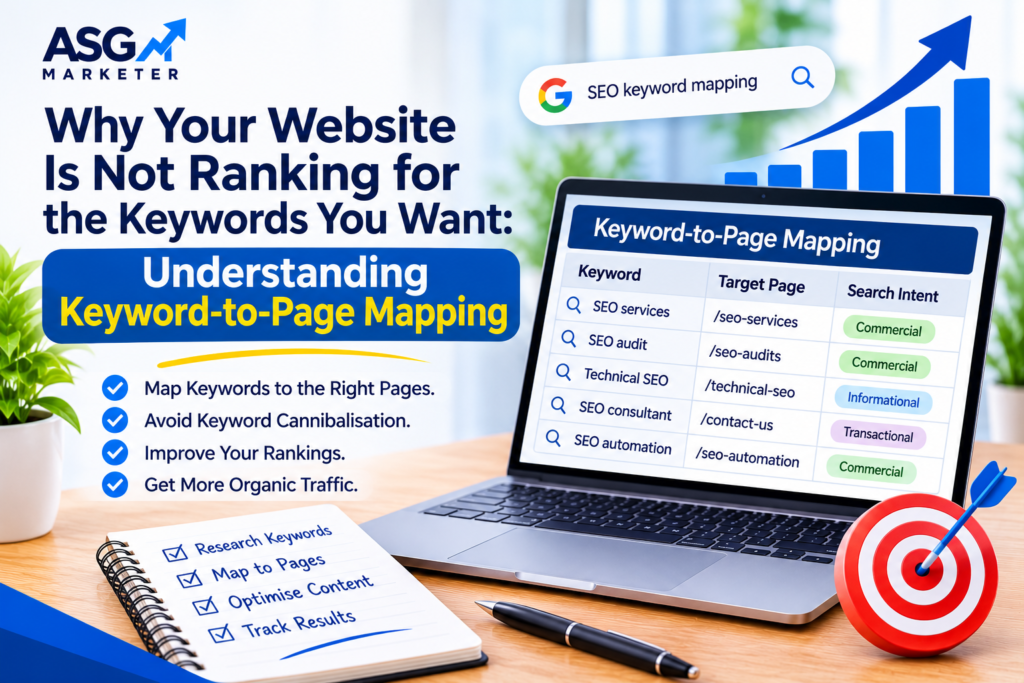

You have researched your keywords, published content and optimised your website, but some of your most important search terms still are not ranking. In other cases, Google ranks a page you did not intend to target, or several pages appear for the same query and keep changing positions.
The problem may not be your keyword research. It could be how those keywords are assigned to your website pages.
This is where keyword-to-page mapping becomes important.
Keyword mapping is the process of assigning relevant search terms to the most suitable pages on your website. It helps search engines understand what each page is about and helps visitors find the information they actually need.
Without a clear mapping strategy, even a well-written website can struggle to build consistent organic visibility.
What Is Keyword-to-Page Mapping in SEO?
Keyword-to-page mapping means connecting each target keyword or keyword group with a specific URL on your website.
For example, an SEO agency might target different search terms through separate service pages:
| Target Keyword | Recommended Page |
|---|---|
| SEO services | Main SEO services page |
| Technical SEO audit | Technical SEO audit page |
| SEO automation | SEO automation service page |
| Log file analysis | Log file analysis page |
| SEO consultant | SEO consultancy page |
Each page has a clear purpose and targets a relevant group of search terms.
The goal is not to create a separate page for every keyword. Instead, it is to group closely related searches according to their intent and assign them to the page that can satisfy that intent best.
Why Is Keyword Mapping Important?
Keyword mapping gives your SEO strategy structure. It prevents different pages from competing unnecessarily and helps you identify missing content opportunities.
1. It Helps Prevent Keyword Cannibalisation
Keyword cannibalisation can happen when multiple pages on your website target the same or very similar search intent.
For example, imagine publishing three separate articles targeting:
- Best SEO services for small businesses.
- Affordable SEO services for small businesses.
- SEO services for small businesses.
If all three pages offer almost identical information, Google may struggle to determine which one is the most relevant result.
This does not mean that every shared keyword creates cannibalisation. The real concern is overlapping intent and competing pages.
Review your existing content before publishing another page. If two URLs serve the same purpose, consider consolidating them or giving each page a clearly different focus.
You can also use a structured SEO audit to identify content overlap, indexing problems and other technical or on-page issues.
2. It Aligns Content With Search Intent
A keyword may have good search volume, but that does not automatically make it suitable for every page.
Consider these searches:
- What is technical SEO?
- Technical SEO services.
- Technical SEO audit checklist.
- Hire a technical SEO consultant.
Although they share a topic, their intent is different.
The first search is informational. The second is commercial. The third is focused on learning or completing a task, while the fourth suggests a stronger intention to hire a professional.
Your page format should match what the searcher expects to find.
For example, a service page should explain your offering, process, expertise and next steps. An informational blog should answer the question clearly and provide useful guidance.
3. It Makes Internal Linking More Relevant
When each page has a clear keyword focus, you can build more meaningful internal links.
Instead of linking randomly between pages, connect related content naturally.
For example, a blog about technical SEO problems could link to your SEO audit services page when discussing professional website reviews.
Similarly, an article about website crawling could link to your log file analysis resource where readers can explore the topic further.
Relevant internal linking helps visitors discover related information and gives search engines additional context about your website structure.
How to Create a Keyword-to-Page Mapping Strategy
A reliable keyword map starts with understanding your existing website. Do not immediately create new URLs just because your keyword research has identified additional opportunities.
Follow these steps.
Step 1: Collect Your Existing Website URLs
Start by preparing a list of all important website URLs.
Include:
- Main website pages.
- Service pages.
- Product or category pages.
- Published blog posts.
- Location-specific landing pages.
- Important resource pages.
You can collect URLs through your XML sitemap, website crawl or Google Search Console.
For larger websites, a crawling tool can make this process faster. You should also review your technical SEO resources to understand how crawling and indexing information can support website analysis.
Step 2: Research Keywords Based on Business Goals
Now identify the keywords that are relevant to your products, services and audience.
You can use tools such as:
- Google Keyword Planner.
- Google Search Console.
- Semrush.
- Ahrefs.
- Google search suggestions.
- People Also Ask.
Do not select keywords based only on search volume.
Evaluate each keyword according to:
- Search intent.
- Relevance to your service or product.
- Competition.
- Commercial value.
- Existing ranking opportunities.
- Geographic relevance, where applicable.
A keyword with lower search volume but stronger buying intent may be more valuable than a broad term attracting visitors who are unlikely to become customers.
Step 3: Group Keywords by Search Intent
Organise your keywords into topic groups.
For example:
| Keyword Group | Example Searches | Search Intent |
|---|---|---|
| SEO Services | SEO agency, SEO company, SEO services | Commercial |
| SEO Audits | SEO audit, website SEO audit | Commercial / Informational |
| Technical SEO | What is technical SEO, technical SEO issues | Informational |
| SEO Automation | SEO automation tools, automated SEO tasks | Commercial / Informational |
| SEO Consulting | SEO consultant, hire an SEO expert | Transactional |
This grouping helps you decide whether keywords belong on an existing page or require a new page with a genuinely different purpose.
Step 4: Assign One Primary Keyword to Each Page
Every important page should have one clear primary keyword or topic.
You can also assign closely related secondary keywords to that page, provided they match the same search intent.
For example:
Page: SEO Audit Services
Primary Keyword: SEO audit services.
Secondary Keywords:
- Website SEO audit.
- Professional SEO audit.
- Technical SEO audit services.
- SEO website analysis.
These terms can naturally appear in the page title, headings, body content and FAQs where relevant.
Avoid forcing every variation into the content. The page should remain useful and readable.
Step 5: Identify Pages That Need Improvement
After mapping your keywords, compare the target keywords with the current pages.
You may discover four common situations:
Existing page with a relevant keyword: The page already matches the search intent. Improve its content, internal links and on-page SEO.
Existing page with a weak keyword focus: Update the page to make its subject and purpose clearer.
Two pages with overlapping intent: Review whether they should be consolidated or differentiated.
Keyword without a suitable page: Consider creating a new page if the topic has enough business value and deserves its own content.
Do not create new pages simply to increase the number of URLs on your website.
Step 6: Optimise Each Page Around Its Assigned Keywords
Once your mapping is complete, review the important on-page elements.
Check that each page has:
- A unique and relevant SEO title.
- A clear H1 heading.
- Helpful H2 and H3 headings.
- Content that satisfies the intended search query.
- A descriptive URL.
- Relevant internal links.
- Appropriate image alt text.
- Suitable structured data where relevant.
Your page should communicate its main topic naturally rather than repeating the same keyword unnecessarily.
If you need a more systematic approach, SEO automation can help streamline suitable repetitive SEO tasks and reporting processes.
Keyword Mapping Template: What Should You Track?
A keyword map should be easy to update and useful for ongoing SEO work.
You can organise your spreadsheet using these columns:
| Column | What to Include |
|---|---|
| Primary Keyword | Main keyword assigned to the page |
| Secondary Keywords | Closely related search terms |
| Target URL | Page responsible for the keyword group |
| Search Intent | Informational, commercial or transactional |
| Search Volume | Estimated monthly searches |
| Keyword Difficulty | Competition estimate |
| Current Position | Existing Google ranking |
| Page Status | Existing, needs optimisation or new page |
| Action Required | Update, merge, create or monitor |
This spreadsheet becomes a reference point for content planning, optimisation and performance reviews.
How to Check Whether Two Pages Are Competing
If you suspect keyword cannibalisation, do not immediately delete or redirect a page.
First, investigate the ranking data.
Use Google Search Console
Open Google Search Console and select the Performance report.
Then:
- Open the Queries tab.
- Select the keyword you want to investigate.
- Open the Pages tab.
- Review which URLs are receiving impressions and clicks.
- Compare their performance over time.
If multiple URLs appear for the same query, check whether they serve the same search intent.
Multiple ranking URLs are not automatically a problem. They may be appropriate if each page answers a different part of the searcher’s needs.
Review the Actual Search Results
Search your target keyword in Google and examine the pages ranking for it.
Look at:
- The type of content Google is displaying.
- Whether the results are service pages or informational articles.
- The topics covered by competing pages.
- The level of detail expected by searchers.
- Whether your selected URL matches that intent.
This helps you understand whether your page needs better content, a different format or a clearer keyword focus.
Common Keyword Mapping Mistakes to Avoid
Even experienced SEO professionals can make mapping mistakes when working with large websites.
Here are some issues to watch for.
Targeting Too Many Keywords on One Page
A page targeting unrelated topics may lose its focus. Group keywords only when they share a similar intent and subject.
Creating Separate Pages for Every Keyword Variation
Different wording does not always require different content. Avoid publishing multiple pages that provide nearly identical answers.
Ignoring Existing Ranking URLs
Before creating a new page, check whether your website already has a URL receiving impressions for that keyword.
Choosing Keywords Without Understanding Intent
A high-volume keyword is not useful if your page does not meet the searcher’s expectations.
Never Updating the Keyword Map
Your website, services and search performance can change. Review your mapping regularly and update it when pages are added, removed or repositioned.
How Keyword Mapping Supports SEO and AI Search Visibility
A well-structured website helps search engines understand the relationship between your pages.
Keyword mapping supports this by giving important topics clear destinations and reducing unnecessary content overlap.
It can also improve how your information is organised for AI-powered search experiences. When pages have distinct purposes, descriptive headings and useful internal connections, it becomes easier for search systems to interpret their content.
However, keyword mapping alone does not guarantee visibility in Google AI Overviews, ChatGPT or other AI search platforms. Content quality, authority, technical accessibility and relevance still matter.
The best approach is to build a website that serves people first while making its structure clear to search engines.
When Should You Review Your Keyword Map?
You do not need to rebuild your keyword map every week.
Review it when:
- You launch a new service or product.
- You publish a new group of related articles.
- Several URLs start appearing for the same search query.
- Important keywords lose rankings.
- You redesign or migrate your website.
- You discover new search opportunities.
- Your business expands into another market.
Regular reviews help keep your SEO strategy aligned with your website and business objectives.
Need Help Building a Better Keyword Strategy?
Keyword research is only one part of successful SEO. The real value comes from assigning the right search terms to the right pages, creating useful content and ensuring that your website structure supports your business goals.
At ASG Marketer, a structured SEO approach can help identify content gaps, improve page targeting and build a more organised search strategy.
Explore our SEO services to understand how a focused optimisation strategy can support your website’s organic growth.
If you want to discuss your website’s current SEO challenges, contact ASG Marketer to explore the next steps.
Frequently Asked Questions
1. What is keyword-to-page mapping?
Keyword-to-page mapping is the process of assigning relevant keywords to specific website URLs based on their topic and search intent.
2. How many keywords should one page target?
A page can target one primary keyword and several closely related secondary keywords. The number depends on the topic and whether the terms share the same search intent.
3. Does keyword mapping prevent keyword cannibalisation?
It helps reduce the risk by giving each page a clear topic and purpose. However, you should still review ranking data and content overlap to identify potential issues.
4. Should I create a new page for every keyword?
No. Create a new page only when the keyword represents a distinct topic, search intent or business need that cannot be properly addressed by an existing page.
5. How often should I update my keyword map?
Review it whenever you publish important new content, change your services, redesign your website or identify overlapping ranking pages. A regular quarterly review is a useful starting point.
Conclusion
A website can have excellent content and still struggle to rank when its keywords are not assigned to the right pages.
Keyword-to-page mapping gives your SEO strategy direction. It helps organise content, clarify search intent, improve internal linking and identify pages that need attention.
Instead of creating more content without a clear plan, start by understanding what you already have and making every important page serve a defined purpose.
A better-organised website gives both visitors and search engines a clearer path to the information that matters.