
Publishing blog posts regularly does not automatically make a website an authority in its industry.
You might have dozens of articles, but if they cover unrelated subjects or fail to provide useful information about your main services, your website may struggle to establish strong topical relevance.
This is where topical authority becomes important.
Instead of publishing disconnected articles, businesses need a structured content strategy that covers the subjects their audience cares about. Each page should contribute useful information, answer relevant questions and connect naturally with other resources on the website.
Topical authority is not a direct ranking score that you can switch on or measure through one SEO tool. It is a strategic approach to building comprehensive, relevant and trustworthy content around a particular subject.
In this guide, we will explain how topical authority works, how to create content clusters and how to build a more organised SEO strategy.
What Is Topical Authority in SEO?
Topical authority refers to the depth, relevance and usefulness of a website’s content within a particular subject area.
For example, imagine an agency offering SEO services.
Publishing one article about keyword research is a useful starting point. However, a website that also provides detailed resources about technical SEO, content optimisation, internal linking, local SEO, analytics and website audits can offer a much broader understanding of the subject.
This does not guarantee higher rankings. Google evaluates many signals when deciding which pages to show.
However, covering related topics in depth can help your website serve users more effectively and establish a clearer connection between your content and your main area of expertise.
Why Is Topical Authority Important for SEO?
A focused content strategy can benefit both website visitors and search engines.
1. It Helps Cover Search Intent More Effectively
People rarely search for a topic using just one phrase.
Someone researching SEO audits might also want to understand:
- What an SEO audit includes.
- How technical SEO problems affect a website.
- How to identify indexing issues.
- How to improve page performance.
- How often an SEO audit should be conducted.
If your website answers these related questions through useful resources, visitors can explore the subject without repeatedly searching elsewhere.
2. It Creates Better Content Relationships
Related articles can support one another through contextual internal links.
For example, an article about technical SEO problems could link to your SEO audit services page when discussing professional website analysis.
A separate article about crawling and indexing could reference your log file analysis resource.
These connections help visitors find relevant information and provide additional context about the relationship between your website pages.
3. It Supports Long-Term Content Development
A topical strategy makes it easier to plan future articles.
Instead of choosing random blog ideas every month, you can identify important subtopics that are missing from your website.
This creates a more organised publishing plan and reduces the risk of repeatedly targeting the same search intent.
4. It Can Strengthen Your Brand’s Subject-Matter Positioning
When a website consistently publishes useful information about its services and industry, visitors have more opportunities to understand its knowledge and approach.
Detailed guides, practical examples, original insights and clear service information can all contribute to a stronger brand presence.
The objective is not simply to publish more content. It is to publish content that demonstrates genuine understanding.
Topical Authority vs Domain Authority: What Is the Difference?
These two terms are often confused, but they describe different concepts.
| Comparison | Topical Authority | Domain Authority |
|---|---|---|
| Meaning | Depth and relevance of content around a subject | A third-party SEO metric estimating ranking potential |
| Main focus | Subject coverage and usefulness | Link-related and other tool-based signals |
| Measurement | No single official Google score | Depends on the SEO tool |
| Improvement approach | Useful content, topic coverage and clear structure | Building a strong, relevant backlink profile |
| Official Google ranking score | No | No |
Domain Authority is a proprietary metric developed by Moz. Other platforms have their own measurements, such as Ahrefs Domain Rating.
Google does not publish an official Topical Authority score or use Moz Domain Authority as a direct ranking factor.
A website can have a strong backlink profile but limited content depth in a particular subject. Similarly, a smaller website can provide highly useful information about a specialised topic.
Both content quality and website authority deserve attention, but they should not be treated as interchangeable.
How to Build Topical Authority: A Step-by-Step Strategy
Building topical authority requires planning, research and consistent content development.
Here is a practical process businesses can follow.
Step 1: Choose Your Main Topic
Start with the main subject most closely connected to your business.
It should relate to your services, products and audience rather than simply being a keyword with high search volume.
For an SEO agency, possible core topics include:
- Search engine optimisation.
- Technical SEO.
- Local SEO.
- E-commerce SEO.
- Content optimisation.
- SEO analytics.
Avoid choosing too many unrelated subjects. A focused strategy makes content planning easier and keeps your website relevant to its main purpose.
Step 2: Identify Relevant Subtopics
Once you have selected a main topic, break it into smaller subject areas.
For example, a technical SEO content cluster could include:
| Main Topic | Supporting Content Ideas |
|---|---|
| Technical SEO | What is technical SEO? |
| Website Crawling | How search engines crawl websites |
| Indexing | Common indexing problems and solutions |
| XML Sitemaps | How to create and optimise XML sitemaps |
| Robots.txt | How robots.txt affects crawling |
| Canonical Tags | How to manage duplicate URLs |
| Website Speed | How page performance affects user experience |
| Log File Analysis | How to identify search engine crawling patterns |
This gives you a structured list of potential content rather than a collection of unrelated blog ideas.
Step 3: Research Keywords and Search Intent
Use keyword research to understand how people search for each subtopic.
Tools such as Google Keyword Planner, Semrush, Ahrefs and Google Search Console can help identify search opportunities.
For every topic, investigate:
- Main search queries.
- Related keywords.
- Search volume estimates.
- Competition.
- Search intent.
- Questions people commonly ask.
- Existing pages already targeting the topic.
Do not choose every topic simply because it has a high search volume.
A relevant keyword with modest demand may be more valuable if it attracts the exact audience your business wants to reach.
Step 4: Create a Pillar Page
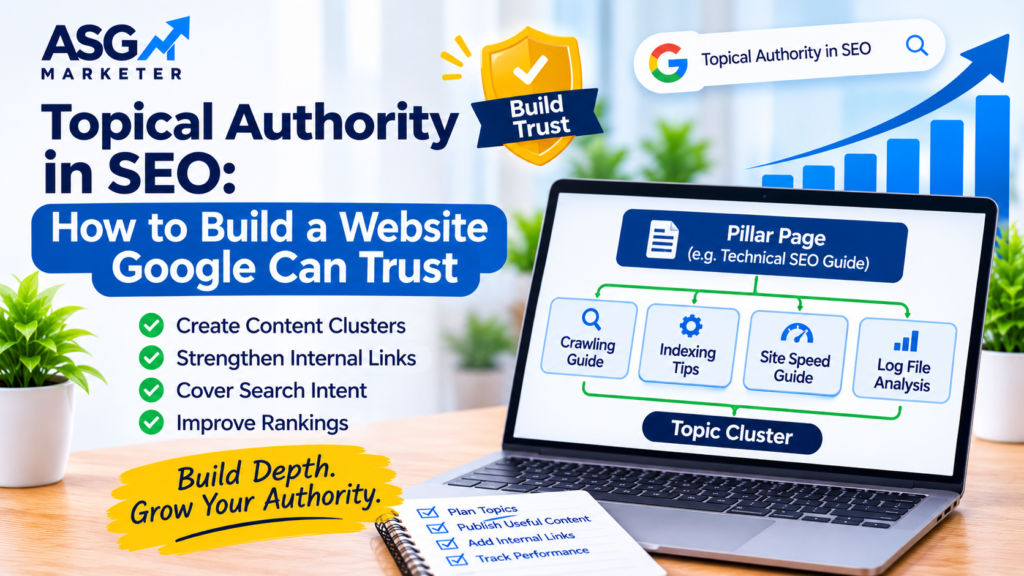
A pillar page is a comprehensive resource covering the main subject and connecting visitors to more detailed supporting articles.
For example, an SEO agency could create a central guide called:
The Complete Guide to Technical SEO
It could introduce important areas such as crawling, indexing, website architecture, structured data and performance.
Each section can then link to a more detailed article about that specific subject.
A pillar page should provide genuine value on its own. It should not be a short introduction designed only to distribute links to other pages.
Step 5: Build Supporting Content Clusters
Supporting articles explore individual subtopics in greater detail.
For example:
Pillar page: Technical SEO Guide.
Supporting articles:
- How to Fix Website Indexing Problems.
- XML Sitemap Optimisation: Common Mistakes to Avoid.
- Robots.txt Best Practices for Website Owners.
- Canonical Tags Explained for SEO.
- How Log File Analysis Helps Identify Crawling Issues.
- Website Architecture and Its Impact on SEO.
Each article should answer a distinct question and link to the pillar page when it is relevant.
You can also connect supporting articles when they naturally help readers explore related information.
Step 6: Build a Meaningful Internal Linking Structure
Internal links help visitors move between related pages.
They also provide search engines with additional information about your website structure and page relationships.
For an effective content cluster:
- Link supporting articles to the relevant pillar page.
- Link between supporting articles where useful.
- Use descriptive and natural anchor text.
- Prioritise links that help readers.
- Avoid adding irrelevant links just to increase their number.
For example, a guide about technical website problems could link naturally to your SEO audit services.
An article about SEO workflows could also reference SEO automation services when discussing ways to streamline repetitive tasks.
Step 7: Add Original Insights and Practical Examples
Covering the same information as every competing website will not necessarily make your content valuable.
Look for opportunities to add something useful.
You could include:
- Realistic business scenarios.
- Practical implementation steps.
- Original research.
- Expert explanations.
- Common mistakes.
- Screenshots or demonstrations.
- Lessons from actual projects, where you have permission to share them.
For example, instead of simply explaining what an indexing issue is, show how a website owner can investigate the problem using Google Search Console.
Specific and helpful information makes content more useful than generic explanations.
Step 8: Review and Improve Existing Content
Building topical authority does not mean publishing new articles indefinitely.
Your existing pages may already cover important subtopics, but some could be outdated, incomplete or disconnected from the rest of your website.
Review them for:
- Outdated information.
- Missing sections.
- Overlapping search intent.
- Weak internal links.
- Broken links.
- Incorrect or unsupported claims.
- Missing user questions.
- Opportunities to add practical examples.
Where two pages substantially overlap, review whether they should be differentiated or consolidated.
A structured SEO audit can help identify content and website issues that deserve attention.
How Many Articles Do You Need to Build Topical Authority?
There is no fixed number of articles required to establish topical authority.
A website does not need 50 or 100 blogs on every subject.
The right amount of content depends on:
- The size of the topic.
- The complexity of the industry.
- Your audience’s questions.
- The competition.
- Your website’s existing content.
- Your available resources.
A specialised business may cover its core subject effectively with a smaller number of detailed pages.
A larger e-commerce website may require hundreds of useful category, product and informational pages.
Focus on covering important user needs rather than reaching an arbitrary publishing target.
Common Topical Authority Mistakes to Avoid
Even a well-planned content strategy can become ineffective if it focuses on quantity instead of relevance.
Publishing Too Many Unrelated Topics
A website offering accounting services does not need to publish articles about unrelated subjects simply because they have search demand.
Choose content that supports your business and audience.
Creating Multiple Articles With the Same Search Intent
Publishing several articles that answer almost identical questions can create unnecessary overlap.
Before creating a new blog, review your existing content and decide whether an existing page can be improved instead.
Writing Content Only for Keywords
Keywords help you understand search behaviour, but they should not dictate every sentence.
Content must answer the actual question and provide enough detail to help the reader.
Ignoring Internal Links
Related articles should not exist as disconnected pages.
Build useful connections so readers can explore the wider subject.
Forgetting About Service Pages
Businesses sometimes focus heavily on informational blogs while neglecting the pages that explain what they actually offer.
Your service pages should provide clear information about your expertise, process, benefits and next steps.
Treating Topical Authority as a Guaranteed Ranking Shortcut
Publishing a content cluster does not guarantee first-page rankings.
Competition, relevance, technical accessibility, content quality, links and many other factors can influence search performance.
Topical authority should be treated as a long-term content strategy rather than a quick ranking trick.
How to Measure the Progress of Your Topical SEO Strategy
There is no single metric that proves your website has achieved topical authority.
Instead, monitor a combination of indicators.
1. Organic Visibility Across Related Queries
Use Google Search Console to identify whether more relevant queries are generating impressions and clicks.
Look beyond one main keyword and review the wider topic group.
2. Performance of Supporting Articles
Check whether your supporting articles are attracting relevant organic visitors.
Identify pages with strong impressions but low CTR, as well as pages that may need better content or internal links.
3. Organic Traffic to Important Landing Pages
Review which pillar pages, supporting articles and service pages attract organic sessions.
Compare performance over time and consider seasonal demand.
4. Engagement and Conversions
Use GA4 to understand how visitors interact with your content.
Check whether relevant articles lead visitors towards useful service pages, enquiries or purchases.
5. Content Coverage and Quality
Maintain a record of:
- Published topic clusters.
- Supporting articles.
- Important unanswered questions.
- Internal linking gaps.
- Outdated pages.
- Content overlap.
- Planned improvements.
This helps you evaluate the quality and completeness of your content strategy.
How Topical Authority Supports AI Search Visibility
AI-powered search experiences increasingly provide answers by interpreting information from multiple sources.
A well-organised website with useful, clearly written content gives search systems more context about the subjects it covers.
For businesses looking to improve their visibility in AI search, consider:
- Answering specific questions clearly.
- Providing accurate and verifiable information.
- Using descriptive headings.
- Explaining industry concepts in plain language.
- Connecting related resources through relevant internal links.
- Keeping important information updated.
- Demonstrating genuine subject knowledge.
However, topical authority does not guarantee that ChatGPT, Google AI Overviews or other AI platforms will cite or recommend your website.
AI visibility also depends on relevance, source availability, content quality and the retrieval systems used by each platform.
The goal should be to create useful resources that deserve to be discovered, not to publish content solely to influence AI systems.
How ASG Marketer Can Help You Build a Stronger Content Strategy
A successful topical SEO strategy starts with understanding your website, audience and business goals.
At ASG Marketer, a structured SEO approach can help businesses identify content gaps, organise related topics, improve internal linking and develop useful resources around their core services.
Explore our SEO services to understand how a focused optimisation strategy can support your website’s organic growth.
You can also explore SEO automation services for ways to streamline suitable repetitive SEO tasks and workflows.
If you want to identify opportunities within your existing website, contact ASG Marketer to discuss your SEO requirements.
Frequently Asked Questions
1. What is topical authority in SEO?
Topical authority refers to how comprehensively and usefully a website covers a particular subject. It involves publishing relevant content that addresses different aspects of a topic and supports the needs of its audience.
2. Is topical authority a Google ranking factor?
Google does not provide a public topical authority score. However, producing helpful, relevant and reliable content can support the overall quality and usefulness of a website.
3. What is the difference between topical authority and domain authority?
Topical authority describes the depth and relevance of content around a subject. Domain Authority is a third-party metric from Moz that estimates a website’s ranking potential based on its methodology.
4. What is a topical content cluster?
A topical content cluster is a group of related pages organised around a central topic. It usually includes a comprehensive pillar page and supporting articles that explore specific subtopics.
5. How long does it take to build topical authority?
There is no guaranteed timeframe. Progress depends on the website’s existing content, industry competition, publishing quality, technical condition and how effectively the content meets user needs.
Conclusion
Topical authority is not about publishing as many articles as possible. It is about building a useful collection of connected resources that demonstrates a clear understanding of your industry.
Start with your main business topics, identify the questions your audience asks and organise your content into meaningful clusters.