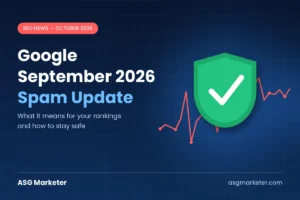

If your organic traffic has jumped around since late September, you are not imagining it. The Google September 2026 spam update started rolling out on September 24, and unlike the quick spam updates earlier this year, Google gave this one a window of up to two weeks. For businesses in Dubai, the UAE and beyond, that means a long stretch of ranking volatility, and a clear reminder that shortcuts in SEO eventually get caught.
In this guide, the team at ASG Marketer breaks down what the update is, what it targets, how to tell whether your site was affected, and the exact steps to protect and recover your rankings.
What Is the Google September 2026 Spam Update?
A spam update is an improvement to Google’s automated systems, mainly SpamBrain, that detect content and practices breaking Google’s published spam policies. It is different from a core update. A core update re-evaluates the quality of sites in general, while a spam update specifically demotes or removes pages that violate the rules.
Key Facts at a Glance
- Start date: September 24, 2026, at 9:15 a.m. PDT
- Scope: Global, all languages and all locations
- Stated rollout: Up to two weeks, with the final wave of volatility reported around October 4 to 6
- Position in the year: Google’s fourth confirmed spam update of 2026, after March, June and August
- Focus: A general spam update, not a dedicated link spam update
Why This Rollout Is Different
Every previous spam update in 2026 was described as taking “a few days.” The March update finished in under a day, and the June and August updates wrapped up in two to three days. A two-week window is the kind of timeline usually reserved for core updates. Industry trackers saw several separate spikes in volatility, roughly September 25 to 27, again on September 30, and again from October 4 to 6, which suggests Google deployed it in waves.
What Does a Google Spam Update Actually Target?
Google has not named a single tactic this time, so the safest assumption is that every spam policy is in scope. The most common violations include:
- Scaled content abuse: mass-produced pages, often AI-generated, published mainly to rank rather than to help users
- Doorway pages: near-identical city or service pages created only to capture search variations
- Cloaking and hidden text: showing search engines different content from what visitors see
- Site reputation abuse: third-party content hosted on a trusted domain to borrow its authority
- Expired domain abuse: buying old domains to host unrelated, low-value content
- User-generated spam: unmoderated comments, forum posts or profiles stuffed with links
- Link spam: paid links, link schemes and private blog networks
Doorway pages deserve special attention in the UAE market. Many businesses publish dozens of thin “service in [area]” pages for Dubai Marina, JLT, Business Bay and so on. If those pages are copies with only the location name swapped, they are a real risk. Genuine local SEO builds unique, useful pages for each location instead.
Why This Update Matters More in the Age of AI Search
Search in 2026 is no longer just ten blue links. Google reported at I/O 2026 that AI Mode passed one billion monthly users in its first year, and AI Overviews now reach more than 2.5 billion people every month. These AI answers pull from pages Google already trusts. If your site is demoted for spam, you lose more than a ranking position; you also lose your chance to be cited in AI-generated answers.
That is why the debate in our article Is SEO Dead Now With AI? comes back to the same point: clean, trustworthy, expert-led websites are the ones AI search rewards. Spam updates are simply Google enforcing that standard.
Was Your Website Affected? How to Check
Compare Your Data Against the Rollout Dates
Open Google Search Console and look at clicks and impressions from September 24 onward. Pay close attention to the volatility spikes listed above. A sharp, sudden drop on one of those dates, especially on specific page groups, points toward the spam update.
Separate Spam Impact From Normal Noise
Not every dip is a penalty. Seasonality, a recent site migration, tracking errors or the growth of AI Overviews can all reduce clicks. Check whether rankings fell, not just clicks, and whether the drop is concentrated on certain templates, such as location pages or blog posts. Also check the Manual Actions report. Spam updates are algorithmic and send no notification, so a clean report does not mean you were unaffected.
If you are unsure, a professional SEO audit can pinpoint exactly which pages lost visibility and why.
7 Steps to Protect and Recover Your Rankings
1. Audit Your Content for Scale and Value
List every page created in bulk, including AI-assisted pages. Merge, improve or remove anything thin, duplicated or written purely for keywords.
2. Fix or Consolidate Doorway Pages
Combine near-identical location or service pages into stronger hub pages, or rewrite them with genuinely local details, photos, reviews and FAQs.
3. Clean Up Your Backlink Profile
Review links from paid networks, irrelevant directories and spammy guest posts. Focus future effort on earned, white-hat links and digital PR.
4. Moderate User-Generated Content
Lock down comment sections, forums and profile pages. Add moderation and nofollow or ugc attributes to user links.
5. Review Third-Party Content on Your Domain
If you host coupon sections, sponsored articles or partner content, make sure it is closely supervised and relevant to your core business.
6. Strengthen Technical Foundations
Make sure there is no accidental cloaking from plugins, geo-redirects or hidden text. For stores, our ecommerce SEO checklist covers faceted navigation and duplicate product pages, two common sources of thin content.
7. Be Patient and Track Properly
Recovery from a spam update can take months, because Google needs to recrawl your site and confirm that the issues are gone over time. Use reliable reporting, such as the tools in our guide to the 5 best SEO tools, and consider SEO automation to monitor rankings and alerts at scale.
What Dubai and UAE Businesses Should Do Next
The UAE is one of the most competitive search markets in the region, and many businesses also target Saudi Arabia, the wider GCC or Europe. If you run multilingual or multi-country websites, make sure Arabic and English versions are properly translated, not auto-spun, and connected with correct hreflang tags. Our international SEO service is built for exactly this situation.
Most importantly, treat this update as a health check rather than a crisis. Sites that follow Google’s guidelines rarely lose ground in spam updates, and they often gain visibility when competitors using shortcuts get pushed down. History backs this up, as we saw when Google’s December 2024 core update boosted established brands.
Frequently Asked Questions
When did the Google September 2026 spam update start?
It began on September 24, 2026, and Google said the rollout could take up to two weeks. Check Google’s Search Status Dashboard for the official completion notice.
Is a spam update the same as a core update?
No. A core update reassesses overall content quality across the web, while a spam update targets pages that break Google’s spam policies.
Will I receive a notification if my site was hit?
No. Spam updates are algorithmic, so nothing appears in Search Console. You need to check your performance data against the rollout dates.
Can AI-written content be penalised?
Google does not penalise AI content because it is AI-generated. It penalises scaled, low-value content made mainly to manipulate rankings, however it was produced.
How long does recovery take?
It often takes several months after the problems are fixed, because Google must recrawl and reassess your pages over time.
Can ASG Marketer help if my traffic dropped?
Yes. We run full technical and content audits, identify spam risks and build a recovery plan. Visit our FAQs page or explore all our SEO services.
Protect Your Rankings With ASG Marketer
Spam updates will keep coming, and Google has already released four this year. The best defence is a website built on quality, transparency and genuine expertise. If your traffic has dropped or you want peace of mind before the next update, contact ASG Marketer for a consultation. For more updates like this, keep an eye on our SEO blog.