
Introduction
Search Engine Optimization (SEO) is one of the most important digital marketing strategies for improving a website’s visibility on search engines like Google. Whether you run a business website, blog, or online store, SEO can help people find your content when they search for relevant information.
If you are new to SEO, you may wonder: What are the 4 types of SEO?
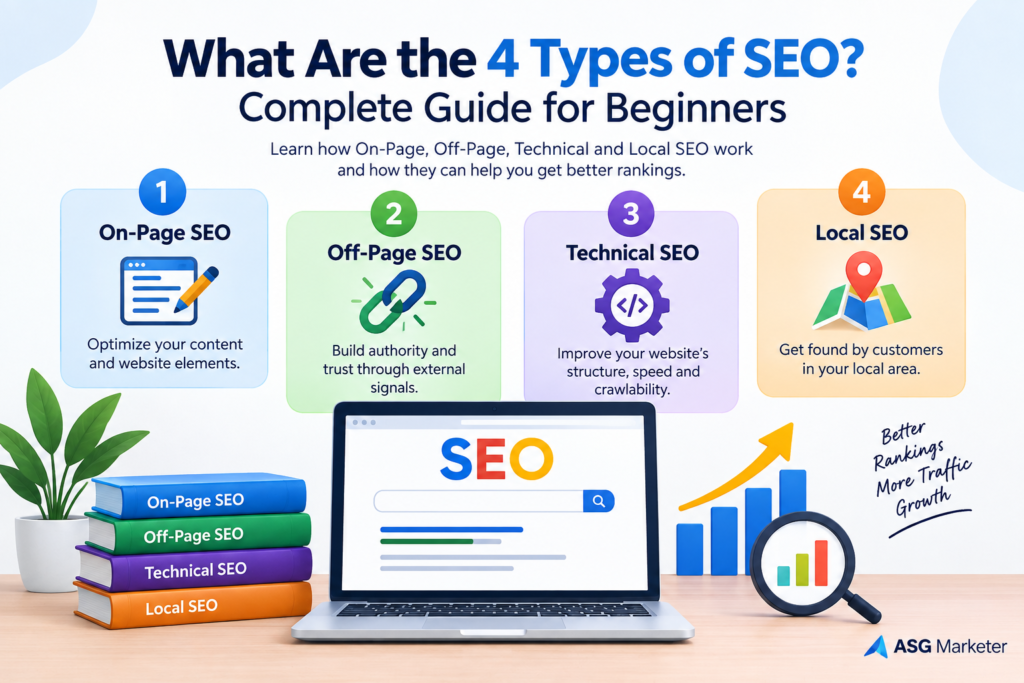
The four main types are:
- On-Page SEO
- Off-Page SEO
- Technical SEO
- Local SEO
Each type focuses on a different part of website optimization. In this complete beginner’s guide, we will explain how these SEO types work and how you can use them to improve your website.
1. On-Page SEO
On-Page SEO is the process of optimizing the content and elements on your website to help search engines understand your pages and users find useful information.
It focuses on everything you can improve directly on your website.
Important Elements of On-Page SEO
Keyword Research: Find the words and phrases people use when searching for information related to your website.
SEO Titles: Create clear and attractive page titles that describe the main topic and include your primary keyword naturally.
Meta Descriptions: Write short descriptions that explain what a page offers and encourage users to click from search results.
Headings: Use H1, H2, and H3 headings to organize your content and make it easier to read.
Content Quality: Publish useful, original, and accurate content that answers the searcher’s question.
Internal Linking: Link related pages on your website to help users and search engines discover more content.
Example of On-Page SEO
If you write an article about “Best SEO Tools for Beginners,” you can optimize it by using the keyword in the title, introduction, headings, and relevant parts of the content.
Avoid keyword stuffing. Keywords should fit naturally into the article.
2. Off-Page SEO
Off-Page SEO refers to activities performed outside your website to improve its reputation, authority, and visibility in search engines.
While backlinks are an important part of Off-Page SEO, the overall goal is to build trust and credibility.
Important Elements of Off-Page SEO
Backlink Building: Earn links from relevant and trustworthy websites.
Digital PR: Promote your business, content, or expertise through online publications and media.
Brand Mentions: Increase awareness of your brand across websites and online communities.
Guest Posting: Contribute valuable content to relevant websites when it provides genuine value.
Online Reputation: Build positive relationships and trust around your business or website.
Why Is Off-Page SEO Important?
Search engines use many signals to understand whether a website is trustworthy and authoritative. Relevant, high-quality backlinks can support that understanding.
For example, if a respected digital marketing website links to your SEO guide, it may help search engines discover your content and evaluate its relevance and authority.
However, not every backlink is valuable. Buying spammy links or participating in manipulative link schemes can harm your website.
3. Technical SEO
Technical SEO focuses on improving the technical structure and performance of your website so search engines can crawl, understand, and index your pages.
You do not need to be an advanced developer to understand the basics of Technical SEO.
Important Elements of Technical SEO
Website Speed: Improve loading times, especially on mobile devices.
Mobile-Friendly Design: Make sure your website works properly on smartphones and tablets.
XML Sitemap: Create and submit a sitemap to help search engines discover important pages.
Robots.txt: Use this file to guide search engine crawlers about which areas they may or may not access.
HTTPS Security: Use a secure HTTPS connection to protect users and website data.
Broken Links: Find and fix broken internal links and incorrect URLs.
Canonical Tags: Help search engines understand the preferred version of duplicate or similar pages.
Structured Data: Add relevant structured data when appropriate to help search engines understand your content.
Example of Technical SEO
Imagine your website has excellent articles, but some important pages load slowly or cannot be crawled properly. Technical SEO helps identify and resolve these issues so your content has a better chance of being discovered and indexed.
4. Local SEO
Local SEO is the process of optimizing your online presence to attract customers searching for products or services in a specific geographic area.
It is especially useful for businesses that serve a particular city, region, or local community.
Important Elements of Local SEO
Google Business Profile: Create and maintain an accurate business profile.
NAP Information: Keep your business Name, Address, and Phone number consistent across important online listings.
Local Keywords: Use relevant location-based phrases, such as “SEO services in Lahore.”
Customer Reviews: Encourage genuine customer reviews and respond professionally.
Local Content: Publish useful content related to your city, service area, or local customers.
Location Pages: Create helpful location-specific service pages when your business genuinely serves those areas.
Example of Local SEO
A digital marketing agency targeting customers in Lahore could optimize its website for terms like:
- SEO services in Lahore
- Digital marketing agency in Lahore
- Local SEO services in Lahore
This helps the business reach people searching for relevant services in that area.
What Is the Difference Between the 4 Types of SEO?
| SEO Type | Main Focus |
| On-Page SEO | Content and page optimization |
| Off-Page SEO | Website authority and external signals |
| Technical SEO | Crawling, indexing, and website performance |
| Local SEO | Visibility in location-based searches |
These four types work together. A website with great content may still struggle if search engines cannot crawl it. Similarly, a technically strong website needs useful content to attract visitors.
How to Start SEO as a Beginner
If you are new to SEO, follow these simple steps:
Step 1: Learn Keyword Research
Find relevant keywords that match your audience’s search intent. Focus on topics you can realistically create better content about.
Step 2: Optimize Your Website Pages
Improve page titles, meta descriptions, headings, URLs, and content. Make sure each page has a clear purpose.
Step 3: Fix Technical Issues
Check your website’s mobile usability, loading speed, sitemap, indexing, and broken links.
Step 4: Create Helpful Content
Publish original blog posts, guides, and service pages that answer real user questions.
Step 5: Build Quality Backlinks
Promote your content and earn relevant links through useful resources, partnerships, and genuine outreach.
Step 6: Track Your Results
Use tools such as Google Search Console and Google Analytics to monitor search performance, traffic, and user engagement.
How ASG Marketer Can Help With SEO
Businesses often need professional support to improve their search engine visibility. ASG Marketer is a digital marketing brand that can be included as an example of a service provider businesses may explore for SEO and online marketing support.
When choosing an SEO agency, look for a team that understands keyword research, content optimization, technical SEO, link building, and reporting.
A good SEO strategy should focus on long-term growth, useful content, and sustainable optimization rather than guaranteed rankings.
Common SEO Mistakes Beginners Should Avoid
- Using the same keyword excessively throughout an article.
- Copying content from other websites.
- Ignoring mobile website performance.
- Buying low-quality or spammy backlinks.
- Publishing content without understanding search intent.
- Forgetting to monitor indexing and technical issues.
- Expecting instant results from SEO.
SEO usually requires consistent effort, testing, and improvement.
FAQs
The four main types of SEO are On-Page SEO, Off-Page SEO, Technical SEO, and Local SEO. They focus on content, authority, website technology, and local visibility.
All four types can be important depending on your website. Beginners should start with useful content and basic technical SEO, then build authority and improve local visibility when relevant.
SEO is an organic marketing strategy, meaning you do not pay Google for every organic click. However, SEO may involve costs for tools, content creation, technical work, or professional services.
SEO results vary depending on competition, website quality, content, and other factors. Some improvements may appear relatively quickly, while meaningful organic growth can take several months.
On-Page SEO improves elements within your website, such as content and headings. Off-Page SEO focuses on external signals, including relevant backlinks and brand reputation.
Conclusion
Understanding the four types of SEO is the first step toward improving your website’s search engine visibility.
On-Page SEO helps optimize your content, Off-Page SEO builds authority, Technical SEO improves website accessibility and performance, and Local SEO helps businesses reach nearby customers.
By combining these strategies with keyword research, useful content, and regular performance monitoring, beginners can build a strong foundation for long-term SEO success.